
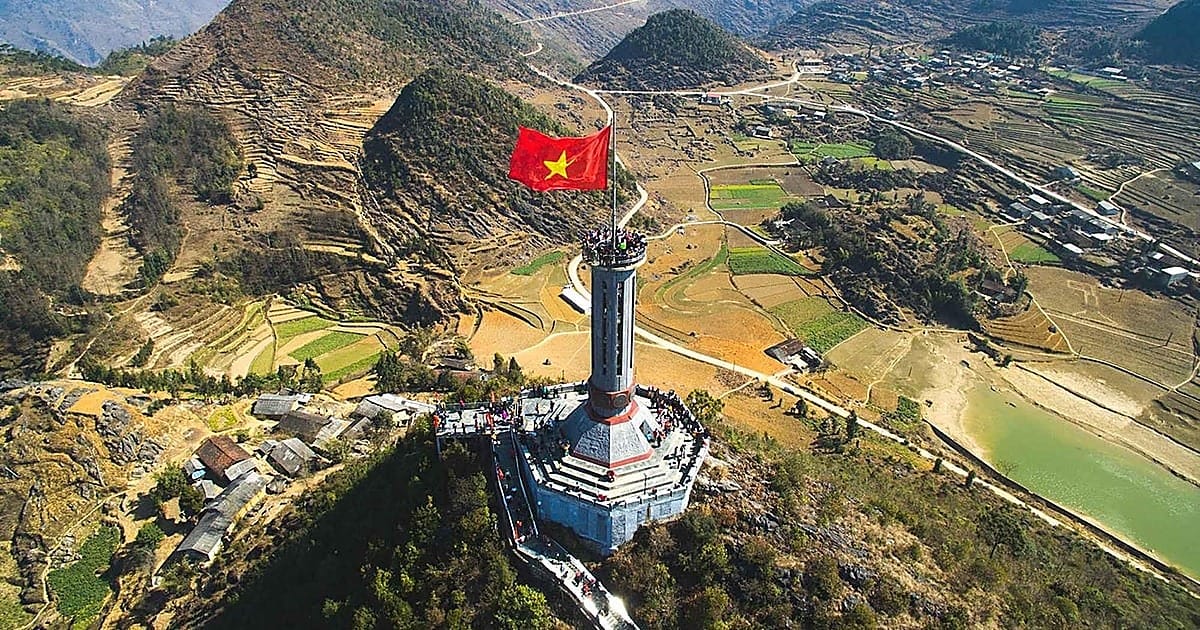
North Vietnam vs South Vietnam: Which one suits your trip
North Vietnam vs South Vietnam comes down to what you want to feel when you step outside. The north has a real winter, mountains, and karst and river scenery you reach by road or boat. The south is warm in every month, flatter, and closer to the Mekong and the islands. Central Vietnam sits between them, and it is the reason a lot of 2-week itineraries end up with three stops instead of two.

Region | Best for | Consider this region if... | Main places |
|---|---|---|---|
North Vietnam | History and natural scenery | You enjoy old neighborhoods, active days, mountain views, and boat trips | Hanoi, Ha Long Bay, Ninh Binh, Sa Pa |
Central Vietnam | Heritage, food, and beaches | You want historic sites and a coastline within a short drive of each other | Hue, Da Nang, Hoi An |
South Vietnam | City life, rivers, and islands | You prefer warm weather year round, late evenings, and tropical scenery | Ho Chi Minh City, Mekong Delta, Phu Quoc |
The climate difference is the real one
The two ends of the country do not share a season. In January, Hanoi sits at 14 to 20C under cold drizzle while Ho Chi Minh City runs 23 to 32C and dry. The south has 2 seasons, dry and wet. The north has 4, and that difference is the whole argument.
The figures below are climate normals, the mean daily low and the mean daily high, from Vietnam Institute for Building Science and Technology and World Meteorological Organization records. They describe a typical month, not the week you travel.
Month | North (Hanoi) | Central (Da Nang) | South (HCMC) |
|---|---|---|---|
January | 14 to 20C | 19 to 25C | 23 to 32C |
April | 22 to 29C | 24 to 31C | 26 to 35C |
July | 27 to 34C | 26 to 34C | 25 to 33C |
October | 23 to 30C | 24 to 30C | 25 to 32C |
December | 14 to 21C | 20 to 25C | 24 to 32C |
One thing the table does not show is storms. The central coast carries the heaviest typhoon and flood exposure in October and November, which is the strongest single reason not to book a beach week there in autumn. It is not a central-coast problem alone, though: Typhoon Bualoi made landfall on 28 and 29 September 2025 and kept heavy rain over northern Vietnam until 1 October, flooding parts of Hanoi. Read any month table as odds, not as a promise.
Two things follow. Travelling in December or January and want to swim? Go south. Travelling in October or November? Check the forecast before committing to the central coast, and keep an indoor option wherever you are. Full month-by-month detail is in our Vietnam weather by month guide.

How far apart they actually are
Hanoi to Ho Chi Minh City is a flight of 1 hour 55 minutes to 2 hours 15 minutes. By train it takes a great deal longer than most people assume, and the number depends on which service you book. On the 2026 timetable the fastest is SE1, leaving Hanoi at 20:50 and reaching Saigon at 05:45 two mornings later: 32 hours 55 minutes. SE3 takes 33 hours 55 minutes and SE9 takes 38 hours 50 minutes. Check the train number, not just the route.
That gap is why the north-or-south question matters at all. It is not a decision you can undo mid-trip without giving up a day to travel.
The line itself runs 1,726 km, the longest railway in Vietnam, completed in 1936 after 37 years of construction. If the journey is the point, it is worth the 33 hours. If you only need to be at the other end, fly.
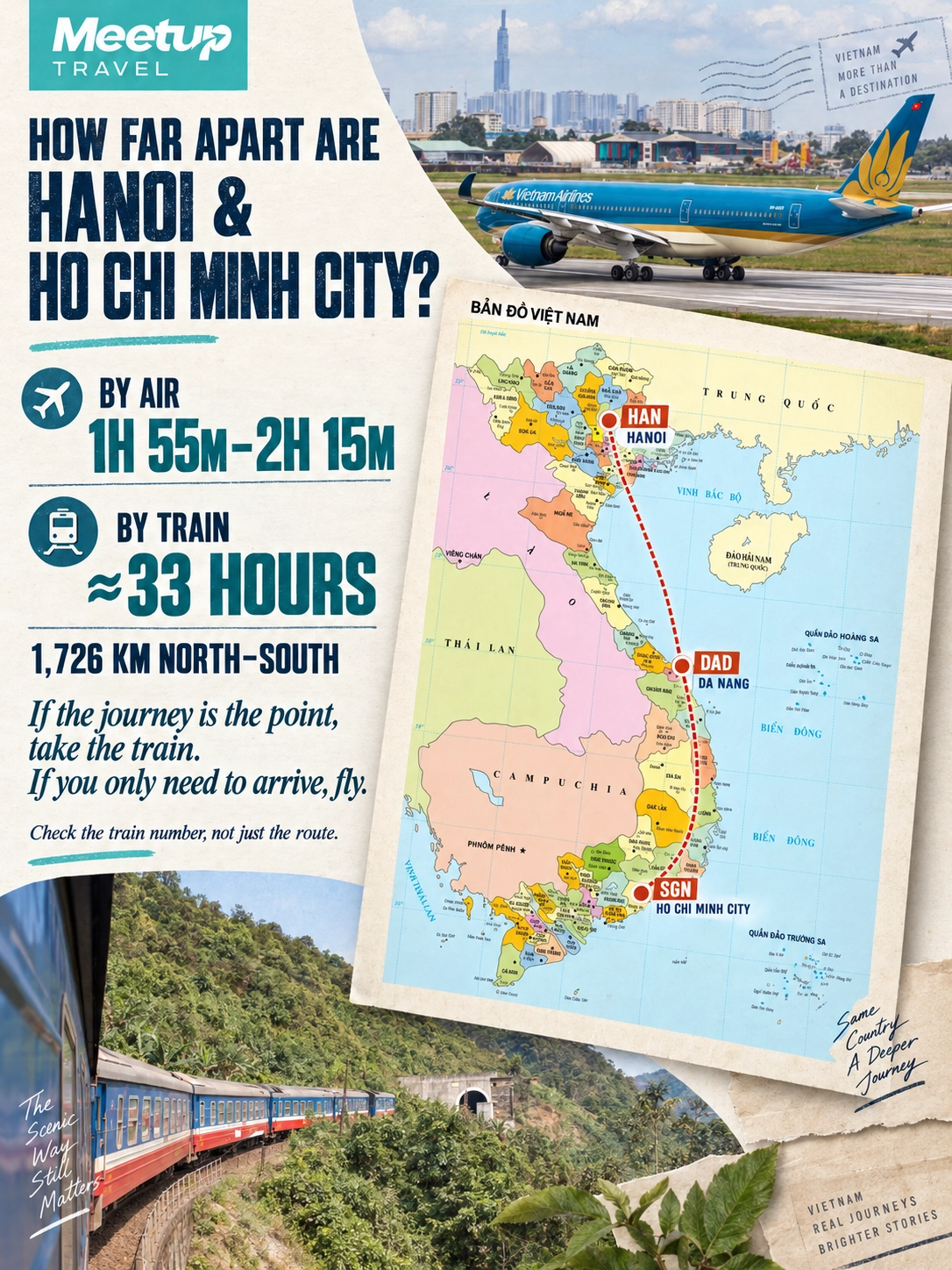
Hanoi uses Noi Bai (HAN), Ho Chi Minh City uses Tan Son Nhat (SGN), and Da Nang (DAD) sits between them with international arrivals of its own. An open-jaw ticket, in to one city and out of the other, means you do not retrace the country to reach your departure airport. How much that saves depends on your route: on a 2-region trip it is usually the difference between one internal flight and two.
Choose North Vietnam if
You want old streets, cool air for at least part of the year, and scenery you reach by road or boat rather than by plane. Hanoi is the compact historic capital and the base for everything else: Ninh Binh is under 2 hours away, Ha Long Bay about 4, Sa Pa an overnight train or a long drive.
The north also has the sharper seasons. February drizzle at 15C is a real thing, and so is the dry brightness of late October. Pack for both. Our Ninh Binh day trip guide covers what fits into one day from Hanoi, and the best time to visit Sa Pa guide is worth reading before you commit to the mountains.

Choose South Vietnam if
You want warm weather in every month, a large city that runs late, and water: the Mekong channels, the islands, the coast. Ho Chi Minh City is bigger and louder than Hanoi, and its restaurants and bars keep going later into the night.
The south is also simpler to move around. Phu Quoc is a 1-hour flight from Ho Chi Minh City and the Mekong Delta is a day trip. The Bien Hoa - Vung Tau expressway opened in May 2026, which makes the expressway run to the coast about 70 minutes, though door to door from a District 1 hotel takes longer than that. What it does have is a wet season, roughly May to November, when afternoon downpours are normal. Most days that costs you an hour. Some days it cancels a boat trip, delays an island transfer or puts water across a street, so give the outdoor parts of your plan a fallback instead of assuming every shower is brief.

When Central Vietnam is a better alternative
Central Vietnam is what people add when they accept that 2 regions is the sensible plan and still want heritage and a beach in the same week. Hue, Da Nang and Hoi An are the 3 stops, and they are not equally close together.
Da Nang to Hoi An is about 30 km, 30 to 45 minutes by car depending on traffic. Da Nang to Hue is about 100 km: roughly 2 hours by road through the Hai Van tunnel, or 2.5 to 3 hours by train over the Hai Van Pass, which is the scenic version of the same trip.

So one hotel does not serve all three equally. Base yourself in Da Nang or Hoi An and the other is an easy evening; Hue from either is a full day out rather than a side trip, and if Hue is a reason you are going, give it a night instead of a return drive. Plan 2 bases if the days allow, or accept that 1 of the 3 gets less than it deserves.
That is the trade-off, not a free upgrade: adding the centre to a 10-day trip means less time at whichever end of the country you came for.
The food splits too
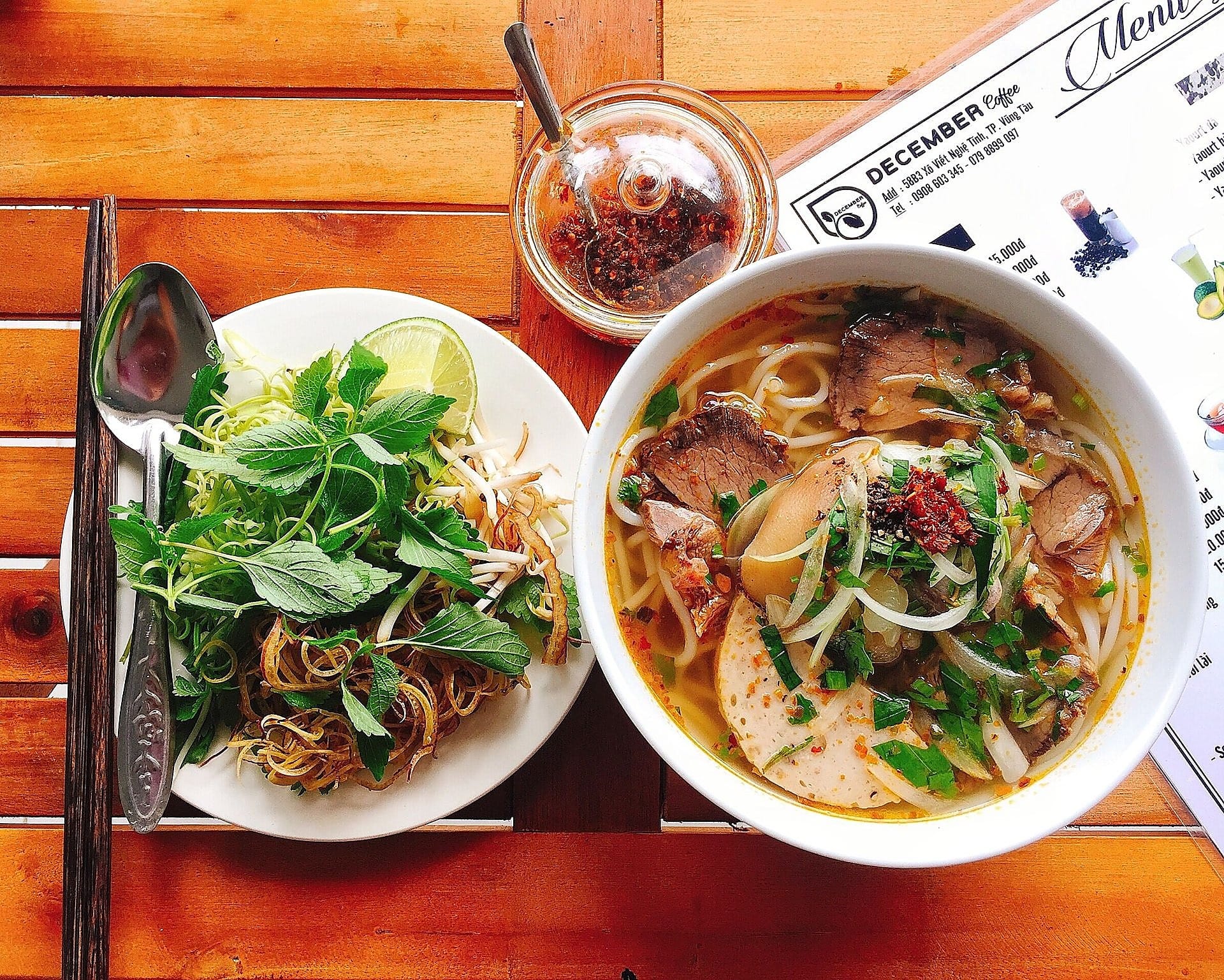
The same dish is not the same dish at both ends. Northern pho is usually served plain: clear broth, flat noodles, spring onion, chilli and lime if you ask. Southern pho usually arrives with a plate of herbs and bean sprouts, hoisin and sriracha on the table, and a sweeter broth. Those are tendencies rather than rules. Plenty of Hanoi shops put herbs on the table and plenty of Saigon shops serve a restrained bowl. Neither version is the corrupted one, whatever anyone tells you over dinner.
Beyond pho the split is clearer. Hanoi means bun cha, cha ca and banh cuon, eaten on a low stool you unfold yourself. Ho Chi Minh City means com tam, hu tieu and banh mi eaten standing up, with a coffee culture built around sitting still through the afternoon heat. Hue, in the middle, has a register of its own: bun bo Hue, banh beo, banh khoai. Some Hue dishes do trace back to the royal kitchens, others are ordinary street food that happens to come from Hue, so treat "imperial cuisine" as a menu label unless the dish earns it.
If food is a main reason for the trip, that argues for 2 regions rather than one.
One week in the north or one week in the south
The clearest way to choose is to put the same 7 days side by side and look at what each week costs you.
One week in the north | One week in the south | |
|---|---|---|
Bases | 2: Hanoi, plus Ninh Binh or a night on Ha Long Bay | 2: Ho Chi Minh City, plus Phu Quoc or the nearer coast |
Transfers | 3 to 4 road or boat legs, no internal flight needed | 2 to 3 legs, including 1 short flight if you add Phu Quoc |
Main days | Hanoi old quarter and museums, Ninh Binh by boat and the Hang Mua climb, a night on the bay, one mountain or countryside day | Central Saigon history and food, a Mekong Delta day, Cu Chi, then beach or island time |
Weather risk | Cold drizzle December to February; typhoon and flooding possible September to October | Afternoon rain May to November; sea conditions can affect island transfers |
What you give up | Beach time. The northern coast is not a swimming proposition for most of the year | Mountains, cool air, and the karst and terrace scenery the north has and the south does not |
Suits you if | You want landscape, seasons and history | You want warmth, city time, rivers and islands |
Both weeks work. The north asks for more hours in a vehicle and gives back scenery the south has no equivalent of. The south asks for a flight if you want an island and gives back warmth you can count on in any month.
One thing overrides both: Tet moves with the lunar calendar and closes family businesses for several days wherever you are. In 2027 the first day falls on 6 February, and transport books out for about a week either side at both ends of the country.
So which region should you choose?
Under a week, take 1 region and let the month decide. December to March favours the south for warmth. September to November favours the north, with the forecast checked before you book anything outdoors.
With 10 days, take 2 regions and let the open-jaw flight set the direction.
With 14 days all 3 are possible, and whether that is a good idea depends on how you build it. Three regions across 3 bases with 2 internal flights is a comfortable trip. Three regions across 6 hotels is a tiring one. The number of hotel changes is a choice you make when you plan, not something the distance forces on you.
Starting in the north? Our Hanoi travel guide and tours covers the base city. Starting in the south, the Ho Chi Minh City guide and tours does the same. Or browse Meetup Travel's Vietnam tour packages to see how the regions get combined in practice, or read the fuller best places to visit in Vietnam guide for the individual destinations.

Sources, checked 15 September 2026. Temperature figures are climate normals, the mean daily low and high, from Vietnam Institute for Building Science and Technology and World Meteorological Organization records for Hanoi, Da Nang and Ho Chi Minh City. Train times are the 2026 timetable for services SE1 to SE9, published by Seat 61. The 1,726 km line length is from Vietnam Tourism. Storm detail is from reporting on the northern Vietnam floods of September and October 2025.
Evie writes Meetup Travel's practical planning series, covering transport, visas, itineraries, timing and safety for visitors arriving in Vietnam.