
Temple of Literature Hanoi: Vietnam's First University
The name "Temple of Literature" is correct, but it can be confusing. Van Mieu, the first part of the name, is a temple. It is a Confucian shrine, built in 1070 to honour Confucius, whose ideas shaped Vietnamese education for centuries. Quoc Tu Giam, the second part, was built six years later, in 1076. It was a school, in fact Vietnam's first university. Here young men studied to become mandarins and serve the emperor. At first only nobles could study. Later, talented students from ordinary families could join too, if they passed the exams.
Most visitors see temple buildings: courtyards, pavilions, a pond, and stone figures. But this place is more than that. For almost 700 years, it trained the scholars and officials who ran the country.
This matters, because it changes what you see in each courtyard.
The Foundation: Why This Complex Exists
In 1070, Emperor Ly Thanh Tong built Van Mieu in Thang Long, the old name for Hanoi. It was a Confucian temple, built in the style of Chinese imperial temples. Confucius never came to Vietnam, but his ideas about ethics, order, and government guided the Vietnamese court for a very long time.
In 1076, six years later, Emperor Ly Nhan Tong added Quoc Tu Giam, which means "school for the sons of the nation". This was Vietnam's first national university. At first, only sons of the royal family and top mandarins could study here. Over time, talented students from ordinary families could join too, if they passed the entrance exams.
The imperial exam system ran from the 11th century until 1919, when the last exams were held. The Temple of Literature covers almost the whole story of that system.
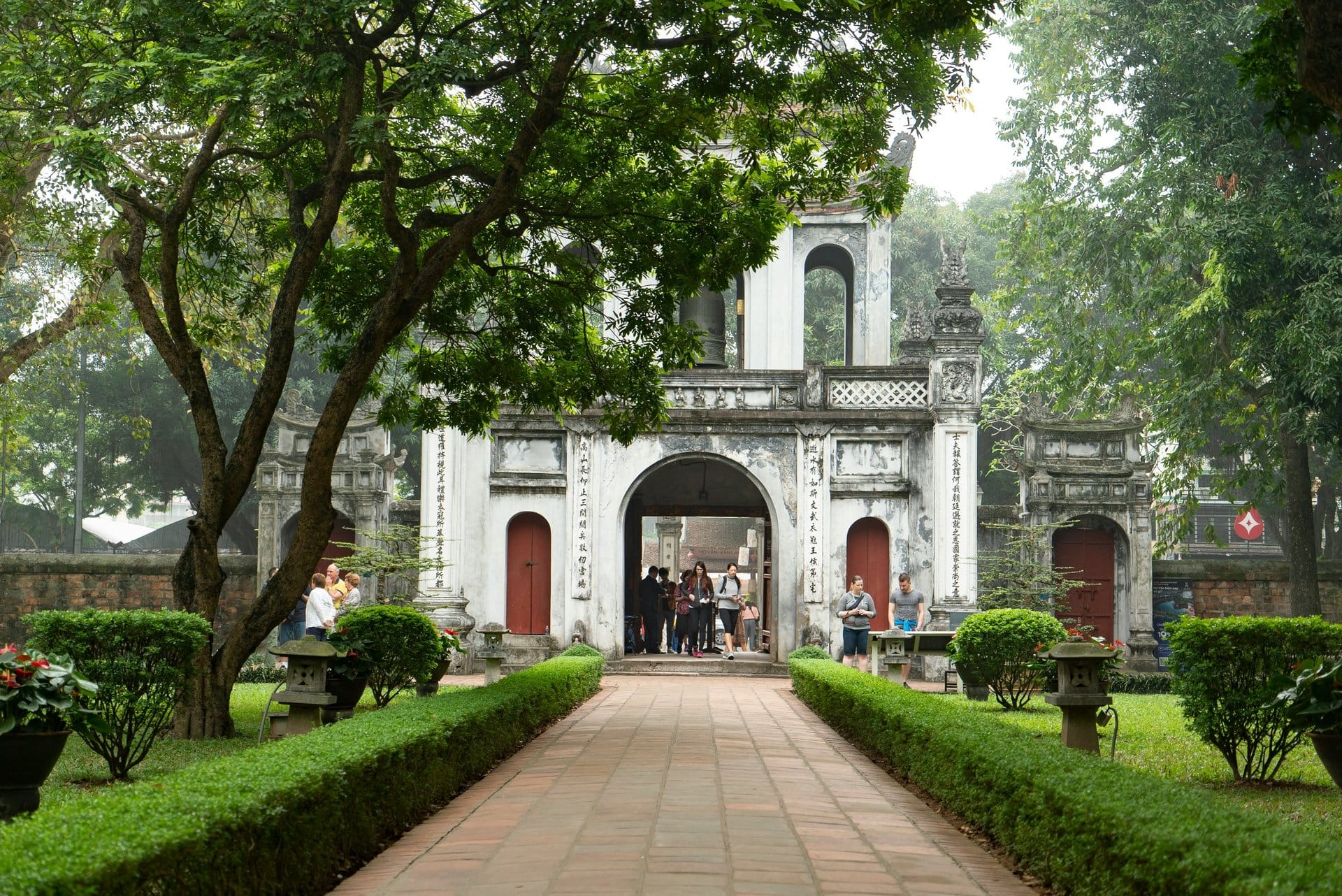
Main gate of the Temple of Literature in Hanoi
For more on how these ideas still shape daily life here, read our guide to Vietnamese culture and etiquette.
The Five Courtyards: A Sequence With Purpose
Courtyard | Key landmark | Purpose |
|---|---|---|
First | Văn Miếu Môn (main gate) | The entrance and a calm start |
Second | Khuê Văn Các pavilion | A ceremonial gate; the symbol of Hanoi |
Third | Well of Heavenly Clarity + 82 stelae | The main part; records of 1,307 graduates (1442–1779) |
Fourth | Đại Thành hall | Where people worship Confucius |
Fifth | Quốc Tử Giám | The old school, now a small museum |
The Van Mieu Gate and the First Courtyard
Enter through the Van Mieu Gate (Văn Miếu Môn) on Quoc Tu Giam Street. This is the south gate, and it is the best way to see the complex in the right order. Many visitors use the west gate on Van Mieu Street and miss the first courtyard. That is a pity, because it is a quiet, tree-lined space. It helps you slow down before you go deeper.
The gate has three doors. The middle door was only for the emperor. The side doors were for mandarins. You see this idea, different doors for different ranks, all over the complex. It was not just design. It showed the social order in stone.
The Second Courtyard: The Constellation of Literature Pavilion
The main sight in the second courtyard is Khuê Văn Các, the Constellation of Literature Pavilion. It was built in 1805, in the Nguyen period. Its red wooden top and round windows became the symbol of Hanoi. You can see it on the back of the 100,000 VND note.
The pavilion is like a doorway from the outer area into the heart of the complex. It was a special place to pass through, not a place to study.
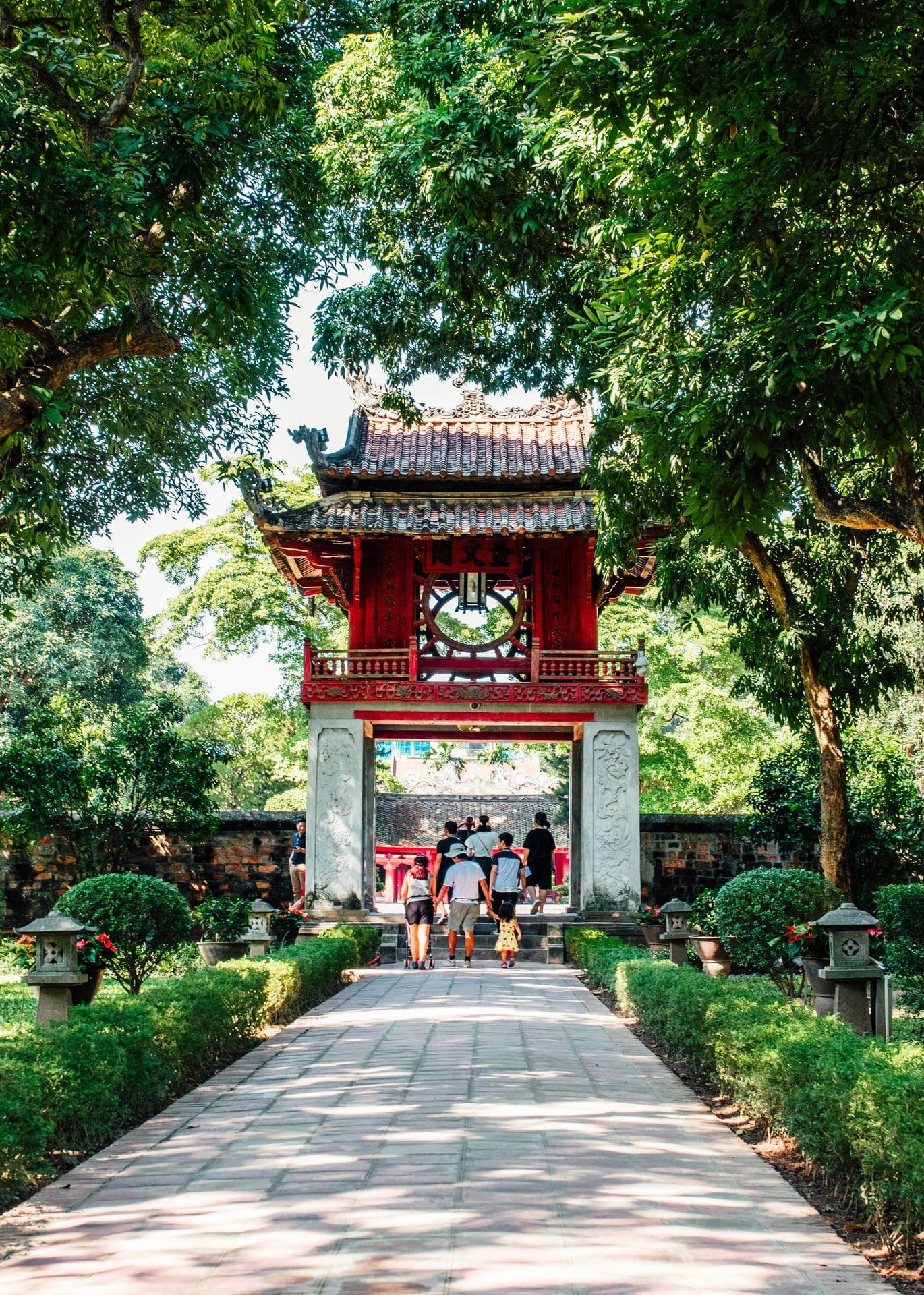
Khue Van Cac pavilion at the Temple of Literature in Hanoi
The Third Courtyard: The Well and the Stelae
The third courtyard is the most important part. In the middle is Thiên Quang Tĩnh, the Well of Heavenly Clarity. It is a square pond, and its reflection is the photo most people know from the Temple of Literature. The clear water was a symbol of a clear, calm mind.
Around the well stand 82 stone stelae. Each one sits on the back of a stone tortoise. They record the names, home villages, and results of 1,307 men who passed the highest exam (Tiến Sĩ) between 1442 and 1779. The tortoise is a symbol of long life and strong roots. Putting a stele on a tortoise was a way to make it last forever.
The oldest stelae are for the 1442 exam. The carving started in 1484, under Emperor Lê Thánh Tông, and continued over the next centuries. The last stelae are for the 1779 exam. After 1779, no more stelae were made, even though the exams went on until 1919.
In 2010, UNESCO added these stelae to its Memory of the World register for Asia and the Pacific, and in 2011 to the world register. They are one of the most valuable written records in the world.
The Fourth Courtyard: The Great House of Ceremonies
The fourth courtyard has the Đại Thành Môn (Great Success Gate) and the main hall behind it. Twice a year, people held Confucian ceremonies here to honour Confucius and his four main students. The hall still keeps its altars.
This is the religious centre of the complex, the "temple" part of Van Mieu. On the altars, Confucius sits in the middle, with the Four Sages beside him and the Ten Philosophers below. The order of the figures follows Confucian teaching, just as the stelae follow the exam system.
The Fifth Courtyard: Quoc Tu Giam
The fifth and last courtyard is Quốc Tử Giám, the university itself. This is where students lived and studied. The buildings you see are new. The old ones were destroyed in 1946, in the fighting at the start of the war with France, and were rebuilt in 1999 and 2000. The signs clearly say which parts are new, which is the honest way to show history.
There is a small museum in this courtyard. It shows the exam system, the types of degrees, the lessons, and the tools of the students, like ink stones, brushes, and exam papers. It is the best place to understand what the school really did.
Visiting Well: The Practical Layer
Timing: Come before 9am on a weekday. The light is soft and the pool gives a clear reflection. It gets busy with tour groups after 10am on weekends.
Admission: There is an entry fee. Check the current price and opening hours at the gate or with your hotel, as they can change.
Location: On Quoc Tu Giam Street, about 2km from the Old Quarter. It is a 25-minute walk from Hoan Kiem, or a short Grab or taxi ride.
What to read: Each gate has a sign about what the courtyard was for. Read it before you go in.
If you prefer to see several sites in one morning, we run a half-day jeep tour of Hanoi.
Where This Fits in Hanoi
The Temple of Literature shows a calm, thoughtful side of Hanoi, very different from the busy Old Quarter or Hoan Kiem Lake. Visit in the morning, when you want to slow down and understand the city, not just look at it.
To fit Hanoi into a longer trip, see our four-day Hanoi and Ha Long Bay itinerary.
Hi, I'm Bichann. I'm a local travel consultant and I cover the wild side of Vietnam: mountains, caves, waterfalls and old heritage sites. Sapa, Ha Giang and Phong Nha are the routes I know best, and I have walked most of them myself, in good weather and bad. Tell me your dates and how much walking you enjoy, and I'll tell you honestly what is worth the drive.