
Hoa Lu Ancient Capital: First Capital of Dai Co Viet
Hoa Lu was the capital of Vietnam for 42 years, from 968 to 1010. Then the court moved to the Red River delta, and the valley went quiet for a thousand years.
People often say the two temples are the main sight. They are not, at least not on their own. Both were first built under the Ly dynasty and rebuilt in the 17th century, so the buildings you see are Later Le style, not 10th-century. The 10th century is still here, but it is in three things that most people walk past, and in the shape of the valley itself. This guide points you to all of them.
Quick Facts
Item | Detail |
|---|---|
Capital years | 968 to 1010 CE (42 years) |
Dynasties | Dinh, then Early Le |
Country name then | Dai Co Viet |
Heritage status | Special National Relic (2012); part of the Trang An Landscape Complex, a UNESCO World Heritage Site since 2014 |
Entry fee | 20,000 VND per person |
Opening hours | About 7am to 5pm or 6pm, depending on the season |
From Hanoi | About 100km, 2 to 2.5 hours by road |
Time needed on site | 1.5 to 2 hours, plus about 1 hour for the tomb climb |
Current address | Tay Hoa Lu ward, Ninh Binh province |
Why an Emperor Chose This Valley
In 968, Dinh Bo Linh needed a place he could defend. He chose a flat piece of ground almost fully closed in by limestone karst mountains.
Here is what that gave him. The rock walls rise up almost straight from the ground, with no easy slope to climb at the bottom. Between them are a few narrow gaps, and the Sao Khe and Hoang Long rivers run through. The Dinh and Early Le courts built walls across the gaps and let the mountains do the rest. So the citadel here is an inner and outer city joined by natural rock, not one long man-made wall.
That choice is the whole story of Hoa Lu. It was great for a young state that expected to be attacked, but it was small and hard to grow in. Forty-two years later, the court left for exactly that reason.
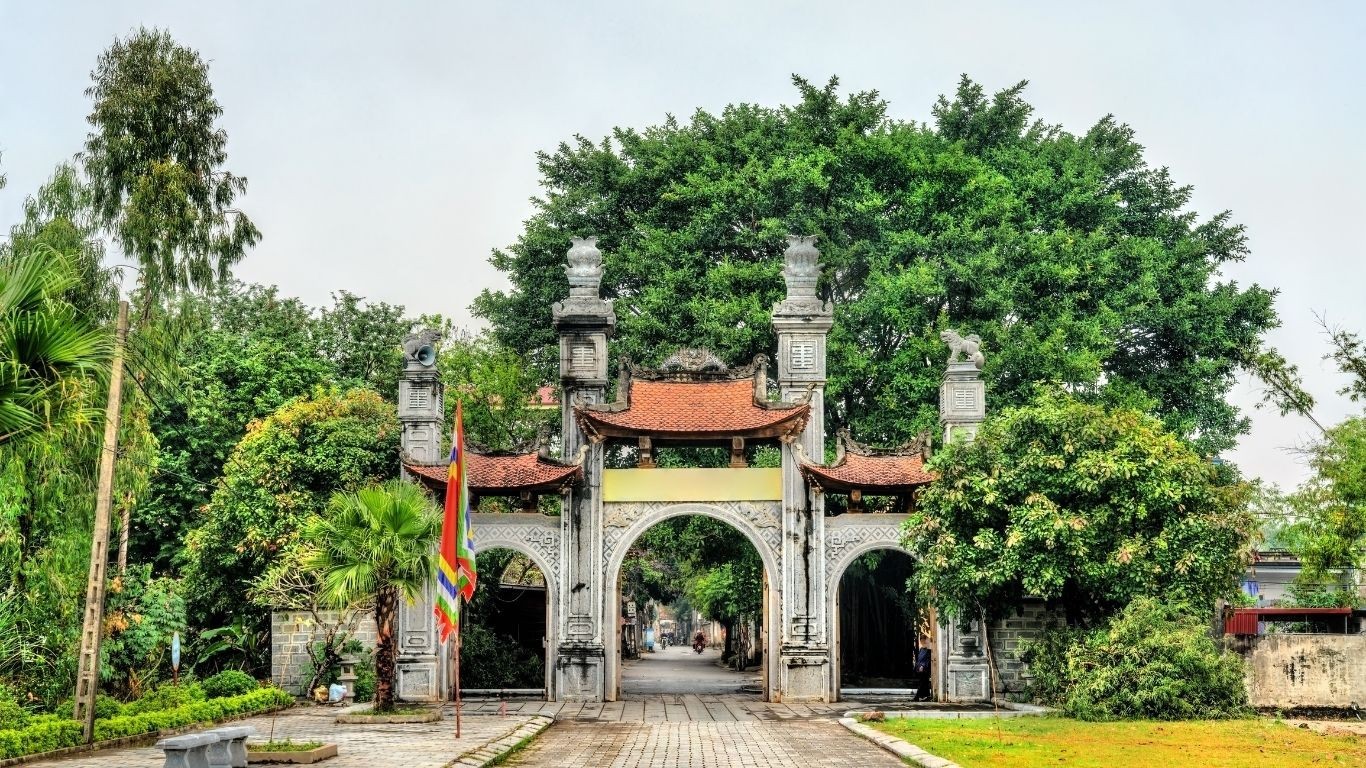
Limestone cliffs surrounding the Hoa Lu valley in Ninh Binh
The Story: Two Dynasties in 42 Years
The Dinh Dynasty (968 to 979)
Before 968, twelve local warlords held the country in pieces. Dinh Bo Linh, from what is now Ninh Binh, beat or absorbed all of them. He took the title of emperor, not king, named the state Dai Co Viet (often translated "Great Viet"), and made Hoa Lu his capital.
In about eleven years on the throne, he built a ranked court of civil and military officials, set up an army, and dealt with the new Song dynasty in China, by force when needed and by tribute when useful. He kept the state independent in practice.
In 979, he and his eldest son Dinh Lien were killed by a court official, Do Thich. This account comes from the Dai Viet Su Ky Toan Thu, the 15th-century royal chronicle.
The Early Le Dynasty (980 to 1009)
The heir was a child. A Song invasion was already forming on the border, so the court and the empress dowager Duong Van Nga gave the throne to the army commander, Le Hoan. He ruled as Le Dai Hanh and kept Hoa Lu as his capital.
The invasion came in the spring of 981, from two sides: a land army through Lang Son, and a fleet coming in by the Bach Dang river.
Le Hoan drove stakes into the Bach Dang, the same trick Ngo Quyen had used against the Southern Han in 938. This did not sink the whole fleet at once. Instead it gave him about two months of delay, roughly February to April 981, so the Song fleet could not join up with the land army. The two forces never met. Alone and waiting, the land commander Hau Nhan Bao pushed south, walked into a planned ambush near today's Soc Son on the edge of Hanoi, and was killed. The rest of the army pulled back.
It is worth being clear here, because the popular story mixes 981 up with "stakes plus tide, like Ngo Quyen". The famous tide trap belongs to Ngo Quyen in 938 and to Tran Hung Dao against the Mongols in 1288. Le Hoan's 981 was a river blockade that broke the enemy's timing, plus a land ambush that finished the job.
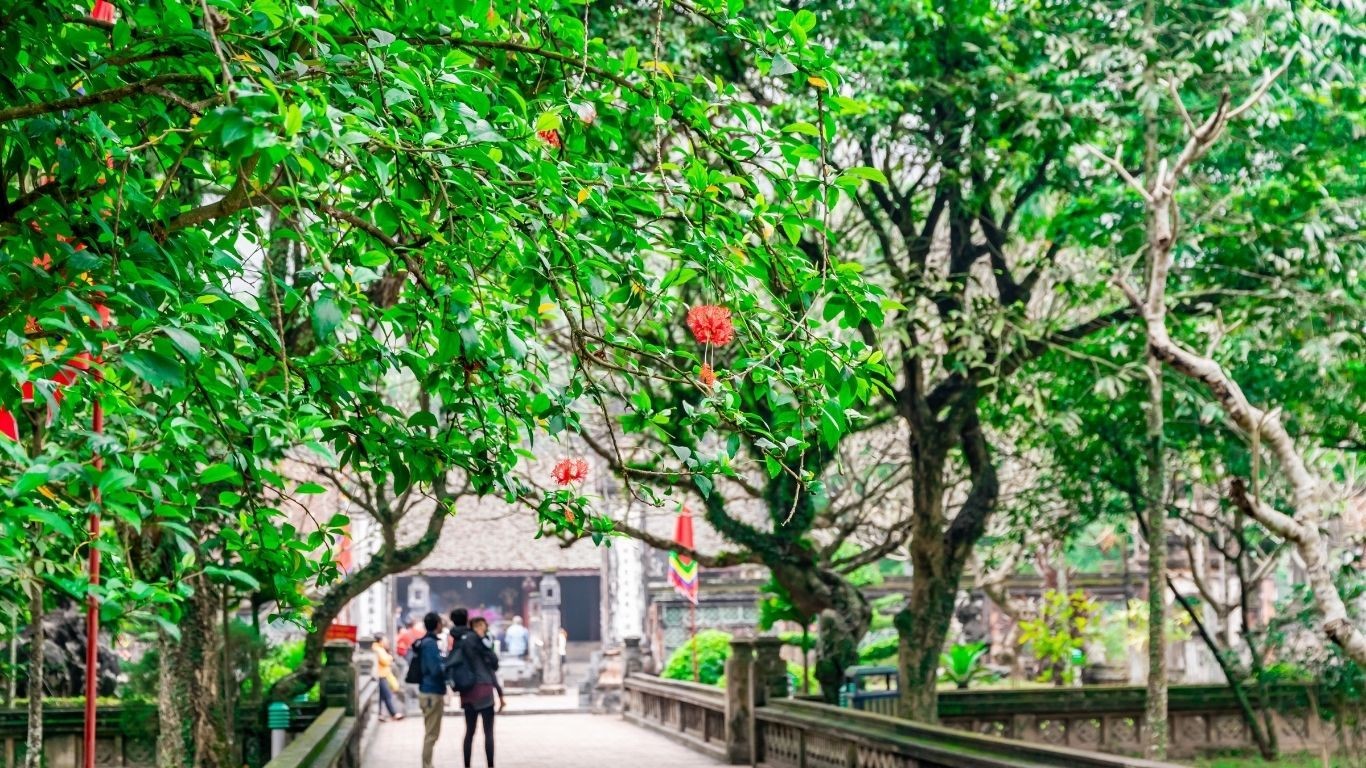
Le Dai Hanh Temple courtyard at Hoa Lu Ancient Capital
The Move to Thang Long (1010)
In 1010, Ly Thai To, founder of the Ly dynasty, moved the capital north to Thang Long, today's Hanoi. He explained his reasons in the Chieu doi do, the Edict on Moving the Capital.
His reasons were about geography and trade, not war. Hoa Lu was small and low. The Dai La site (Thang Long) sat in the centre of the country, on open, high, flood-free ground where trade and people could grow. A fortress had done its job; a capital now needed room.
Hoa Lu stopped being a political centre that year and never became one again. The temples you visit were built about six centuries later.
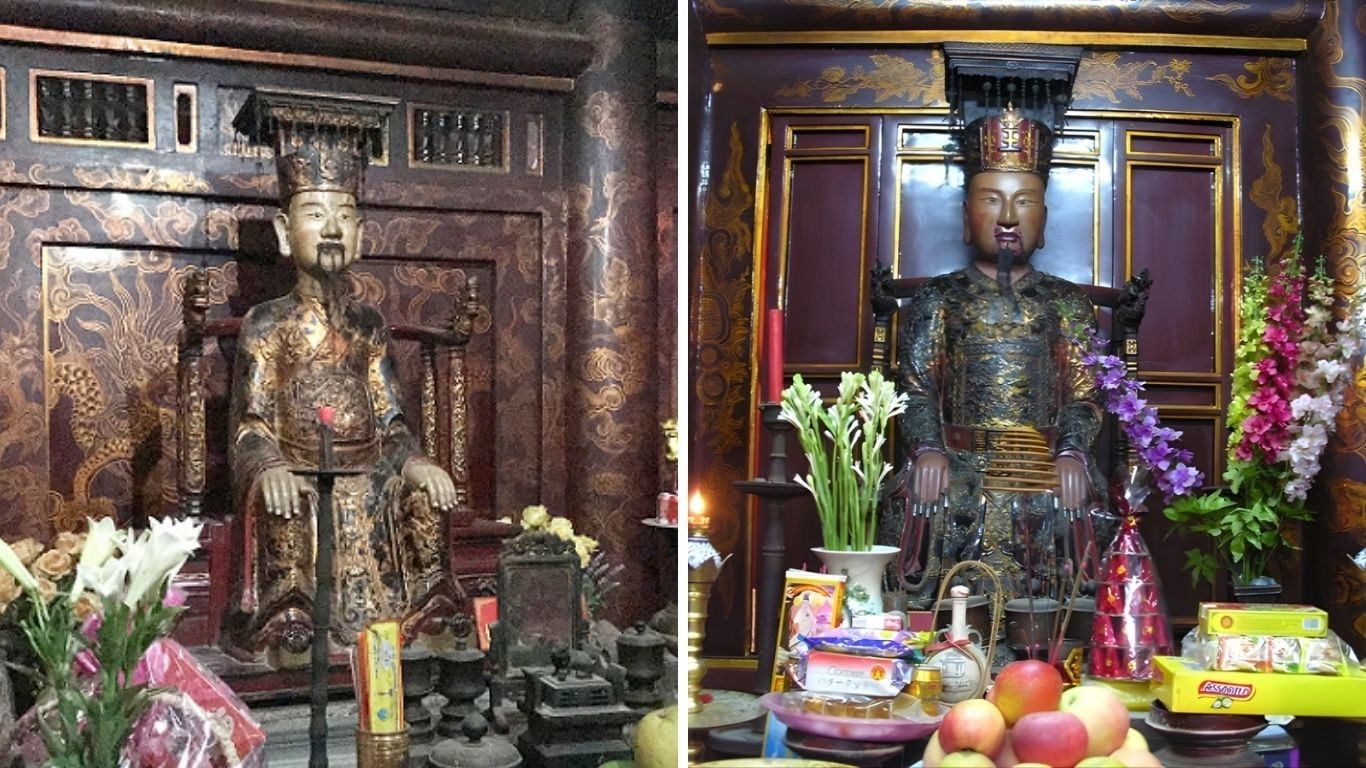
Statues of Emperor Ly Thai To and Emperor Dinh Tien Hoang
What Actually Survives from the 10th Century
This is the part most tours skip, and it is the reason to come.
The stone sutra pillar at Nhat Tru Pagoda. Le Dai Hanh had it raised in 995, and it still stands in the pagoda courtyard, about 100 to 150 metres north of the temples. It is 4.16 metres tall, weighs about 4.5 tonnes, and is made of six separate stone pieces slotted together with no mortar: a square base, a round plinth, an eight-sided shaft, an eight-sided disc, an eight-sided capital, and a lotus top. About 2,500 Chinese characters, a Buddhist prayer text, were carved on the eight faces of the shaft, and the writing names the "Thang Binh emperor", which is Le Hoan's reign title. Much of the lower half has worn blank. It is a National Treasure, and the oldest stone sutra pillar in Vietnam still standing where it was first raised.
The tomb on Ma Yen mountain. Dinh Tien Hoang was buried on top of the ridge in front of his own temple. The idea was that a warrior emperor should stay "in the saddle" even in death. Ma Yen means "horse saddle", which is the shape of the ridge. A stone stairway climbs to it.
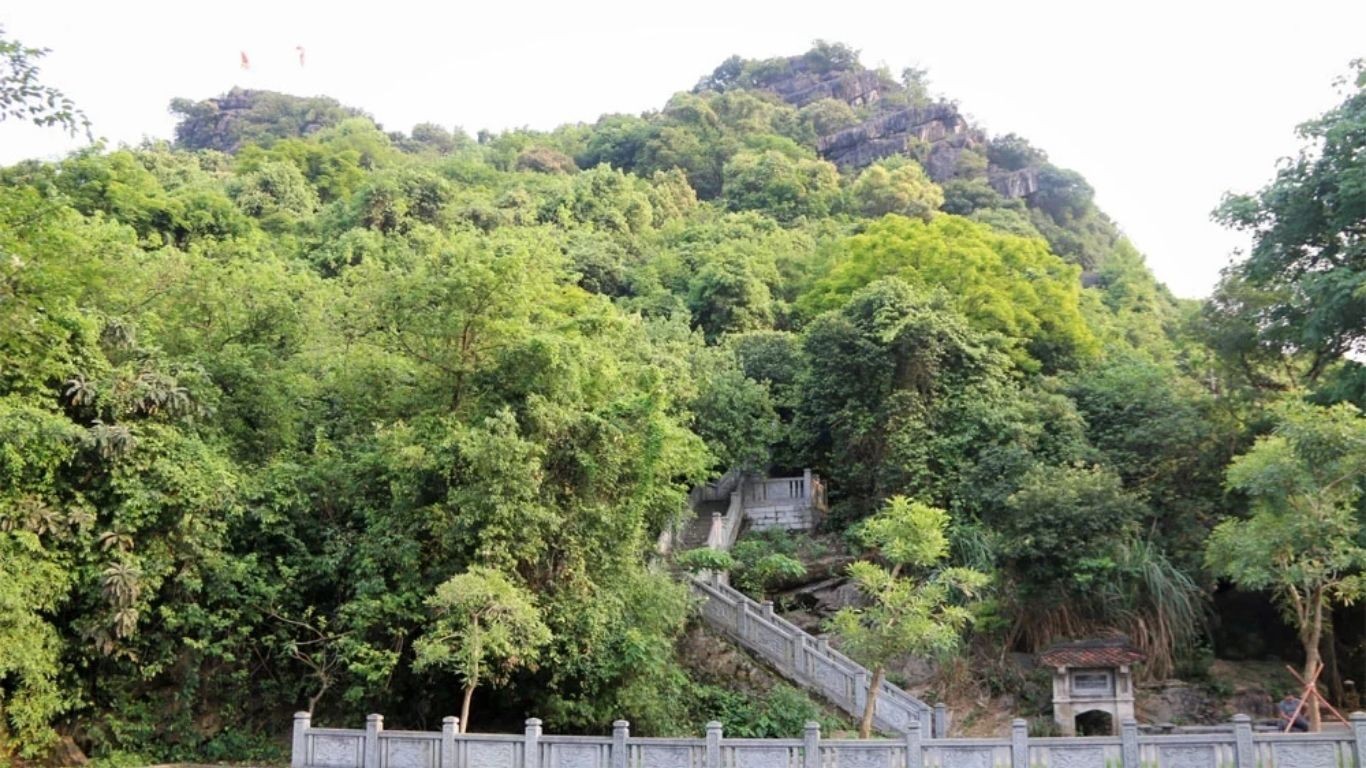
Ma Yen mountain
The ground itself. The old citadel walls, the flagpole hill in the northeast where the Dai Co Viet flag flew, and the caves that held the treasury and the salt store. You are walking on the palace grounds, not just near them.
And the oldest writing of all, though it is not here anymore. A set of smaller stone sutra pillars, each about 1.4 metres tall and 120kg, was raised between 973 and 979 by Dinh Lien, the eldest son of Dinh Tien Hoang, partly to atone for killing his own younger brother. They were found from 1963 on, in the ground and in the Hoang Long riverbed. Now 29 of them are in the Ninh Binh Provincial Museum, made a National Treasure in January 2024. They are two decades older than the Nhat Tru pillar and carry the only writing that survives from the Dinh dynasty. If you want the full picture of 10th-century Hoa Lu, the museum is the other half of the visit.
What You'll See at the Site
Dinh Tien Hoang Temple
This is the main temple, built in the noi cong ngoai quoc layout, on the site of the old throne hall. It faces east, with the saddle ridge of Ma Yen mountain in front as the "screen mountain" in the classical siting rules. The temple is not turned away from the land; it is aimed at it.
What to look at, in order:
The two stone couches (long sang), one in front of the outer gate and one before the front hall. These are National Treasures, ritual furniture made under the Le-Trinh court. Most visitors walk over the first one without seeing it.
The stone and wood carving, from the 17th to 19th centuries: dragon mothers with young, groups of dragons, and immortals riding dragons. Later Le workshop style, and among the best anywhere.
The stone nghe, the guardian animals. Researchers use them as a model for how Vietnamese, not Chinese, guardian figures should look.
The grounds, about five hectares, with old trees, a lotus pond, and a rock garden between the gates.
Le Dai Hanh Temple
About 300 metres north along a stone path, smaller and usually much quieter.
Inside are Le Dai Hanh, Empress Dowager Duong Van Nga, who was empress to two dynasties and gave up the throne at the key moment in 979, and Le Long Dinh, the last Early Le emperor. There are also tablets for princess Le Thi Phat Ngan and the general Pham Cu Luong.
The wood carving here is pure 17th-century Later Le work, and it is the reason to slow down. Look for the paired dragons around a bodhi leaf, and the immortals riding dragons on the beam ends. The temple faces Den mountain and the Sao Khe river, with the old moat running behind it under Dia mountain.
Nhat Tru Pagoda
About a hundred metres further north, founded in 995, and where the sutra pillar stands. It takes ten minutes, and almost no tour group goes. If you remember one object from Hoa Lu, make it this one: it is the only thing on site that Le Dai Hanh himself would recognise.
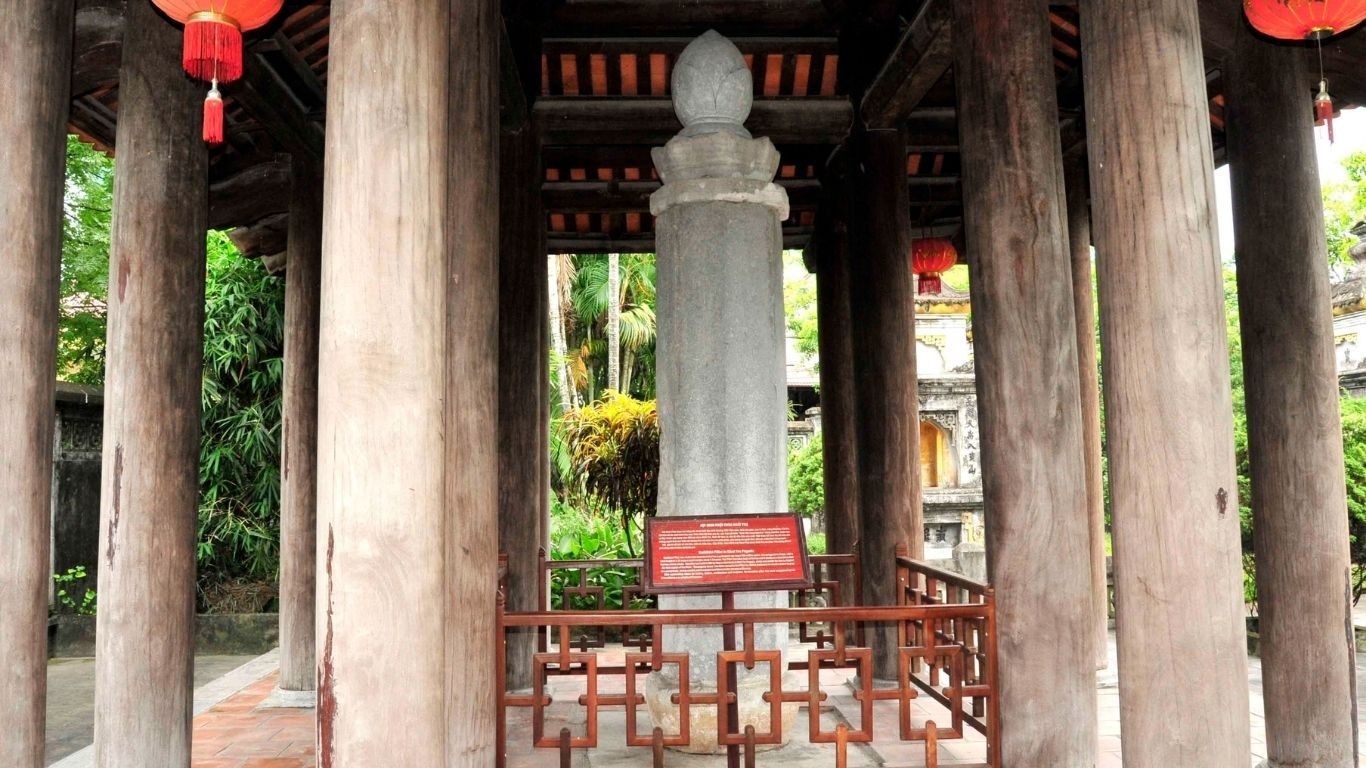
Stone sutra pillar at Nhat Tru Pagoda in Hoa Lu
The Climb to the Tomb
The stairway up Ma Yen starts near Dinh Tien Hoang Temple. People report anywhere from 150 to 265 steps, which tells you how many finish counting. Either way, it is steep in places and has no shade. From the top you get the point of the whole guide: the valley seen as a plan, not just a view. You can see the ring of karst standing around it like a wall, the gaps where the roads run, and the Hoang Long curving away.
Allow 45 minutes to an hour round trip. Skip it in heavy rain, as the steps get slippery.
Address and Naming: What Changed in 2025
If your map app, brochure, or older blog gives a different address, this is why.
Two separate changes hit this area:
1 January 2025: Ninh Binh city and Hoa Lu district were joined into one Hoa Lu city, which removed "Hoa Lu district" as an address.
1 July 2025: Ha Nam, Nam Dinh, and Ninh Binh provinces were joined into one bigger Ninh Binh province. Vietnam changed to a two-level system of province and commune, the district level was removed, and the commune map was redrawn. Truong Yen commune was merged with several nearby wards and communes to form a new ward called Tay Hoa Lu.
Address you may see | Current address |
|---|---|
Truong Yen commune, Hoa Lu district, Ninh Binh province | Tay Hoa Lu ward, Ninh Binh province |
Truong Yen still exists as the old village name, and locals still use it. It is no longer an official unit. The site has not moved.
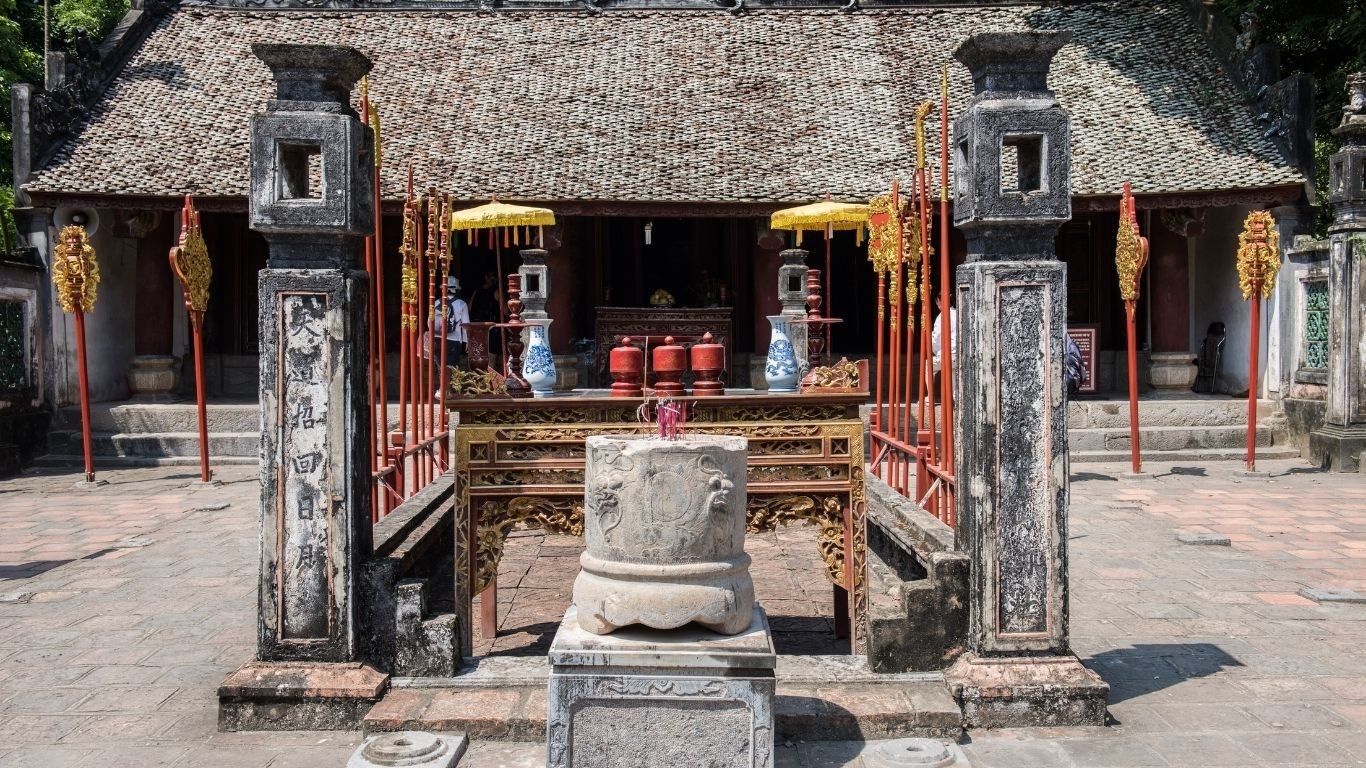
Hoa Lu heritage site in Tay Hoa Lu ward, Ninh Binh province
How to Fit Hoa Lu Into Your Day
Hoa Lu sits in the same karst basin as Trang An, and close to Tam Coc and Mua Cave, so most people combine them.
If you would rather not plan the driving, we run a full-day Hoa Lu, Trang An and Mua Cave tour.
Option A: Hoa Lu + Trang An (full day)
Time | Activity |
|---|---|
8:00am | Leave Hanoi |
10:30am | Hoa Lu: two temples, Nhat Tru Pagoda, about 1.5 hours |
12:00pm | Lunch nearby (80,000 to 150,000 VND per person) |
1:00pm | Trang An boat route (2.5 to 3 hours) |
4 to 5pm | Return to Hanoi |
Option B: Hoa Lu + the tomb climb + Mua Cave (half to full day)
Time | Activity |
|---|---|
8:00am | Hoa Lu temples and Nhat Tru (1.5 hours) |
9:30am | Ma Yen tomb climb (1 hour) |
Late morning | Mua Cave, a short drive away |
Afternoon | Lunch, then back |
Two staircases in one morning is a lot of steps. If you only want one, the Mua Cave view is more photogenic, and the Ma Yen view makes more sense of the history.
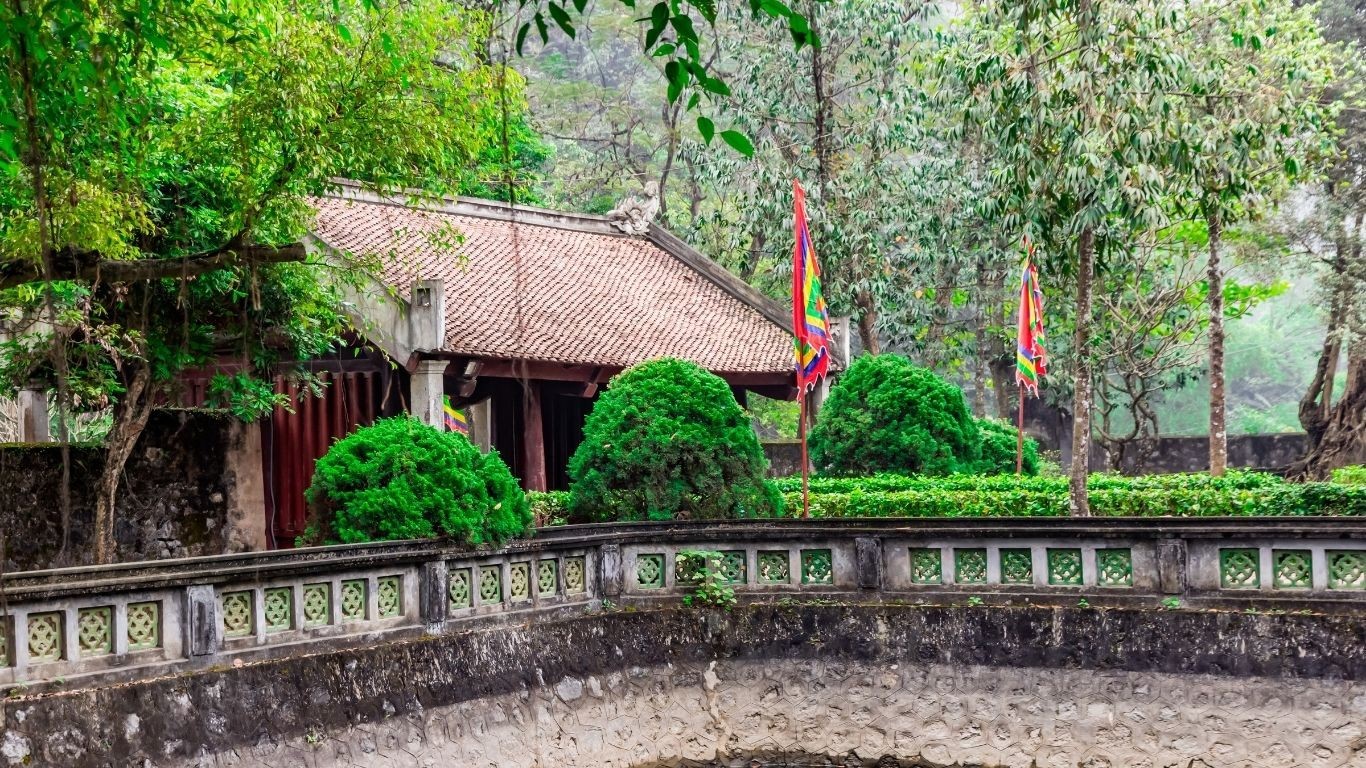
Hoa Lu Ancient Capital landscape
Practical Info
Item | Detail |
|---|---|
Address | Tay Hoa Lu ward, Ninh Binh province |
Heritage status | Special National Relic (2012); within the Trang An Landscape Complex, UNESCO World Heritage 2014 |
Entry fee | 20,000 VND per person; reduced and free categories are set locally, so check the board at the gate |
Opening hours | About 7am to between 5pm and 6pm daily, depending on the season. Arrive before 4pm to be safe |
Site management board | 0229 3620 099 |
Guiding | Call the site management board in advance to arrange a guide. Guides can also be hired at the gate, priced per group |
Dress code | Cover shoulders and knees; these are working temples |
Distance from Hanoi | About 100km, 2 to 2.5 hours by road |
Best time of year | The Hoa Lu Festival runs on the 8th to 10th days of the third lunar month, at the old capital. It is big and loud, with a water procession and folk games. Come for it or avoid it on purpose |
For the wider picture, see our Ninh Binh travel guide, or our notes on a day trip from Hanoi to Ninh Binh.
Getting There from Hanoi
Private car or tourist bus: 2 to 2.5 hours. Group day tours are sold widely in Hanoi's Old Quarter.
Train plus taxi: Hanoi station to Ninh Binh station takes about 2 hours, then a short taxi or xe om to the site.
Meetup Travel runs guided Ninh Binh tours from Hanoi with a history-trained guide.
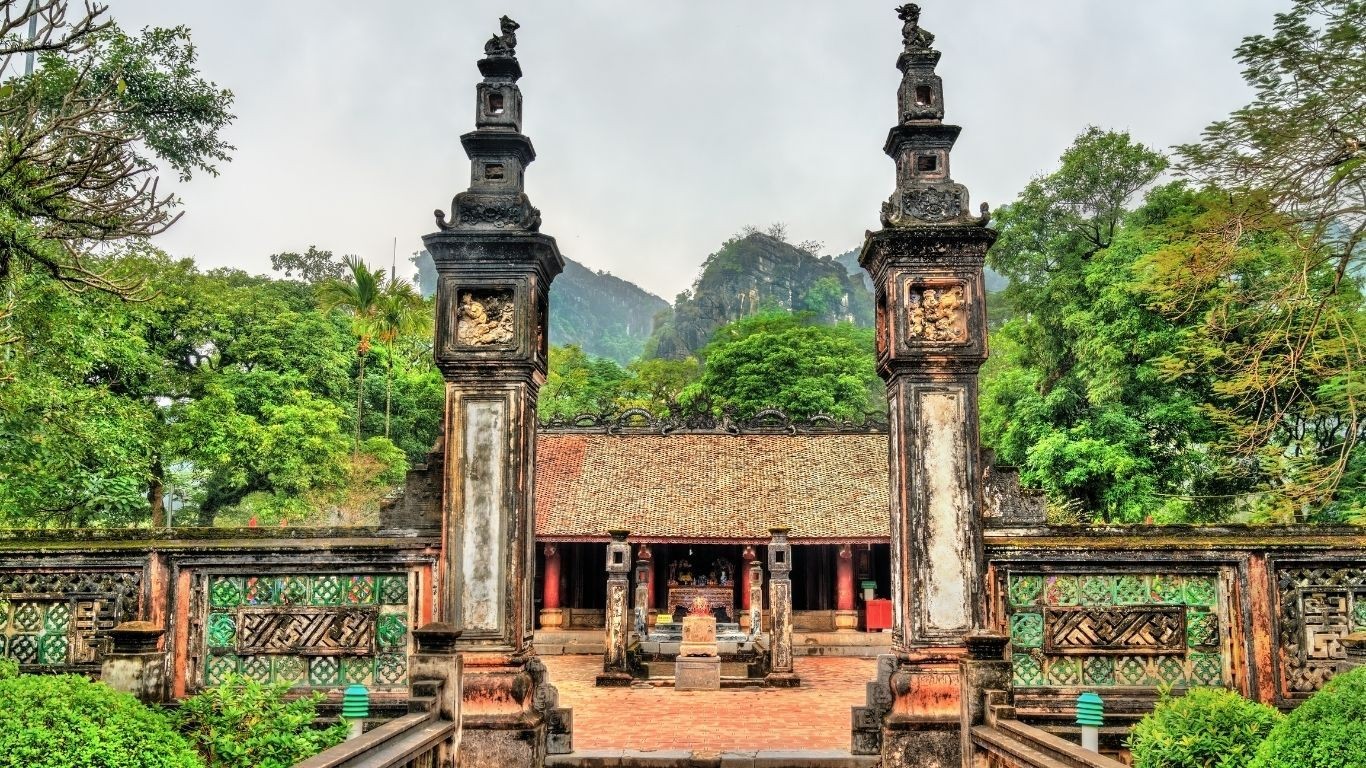
Visitors at the Hoa Lu Ancient Capital on a day trip from Hanoi
Three Things Worth Doing That Most People Don't
Find the stone couch before the outer gate of Dinh Tien Hoang Temple. It is a National Treasure, and it lies in the open where everyone steps past it.
Walk the extra hundred metres to Nhat Tru Pagoda. The 995 sutra pillar is the oldest thing you can touch here, and there is usually nobody at it.
Climb Ma Yen if your knees allow. From the top, the valley stops being scenery and becomes a floor plan, and the reason for choosing this spot in 968 explains itself with no information board.
Hoa Lu is not the biggest or the most spectacular historical site in Vietnam. If you come expecting a preserved imperial city, you will be let down. What is here is a valley chosen for one job, a court that lasted 42 years and then correctly decided that job was done, and three objects that have sat here through the whole thousand years since. That is a small, clear window into how Vietnam became a country, and it costs 20,000 dong.
Hi, I'm Rosie. I was born and raised in Hanoi, and I work as a travel consultant at Meetup Travel. I look after the paperwork side of a Vietnam trip: eVisas, airport transfers, and what a tour quote should really include. I have walked more than 200 first-time visitors through Vietnam entry procedures. Tell me your dates and I'm happy to check the details for you.