

Ninh Binh Travel Guide: Top Sights & Where to Stay
Ninh Binh (which absorbed the former Ha Nam and Nam Dinh provinces in the July 2025 merger) sits about 90 km south of Hanoi, and its best-known sights cluster within a 20 km radius: karst limestone peaks, a UNESCO-listed boat cave system, and the ruins of Vietnam's 10th-century imperial capital, all reachable in a day trip or a relaxed overnight stay. Most visitors spend one to two days rowing through the Trang An cave system, climbing the stone steps of Mua Cave for panoramic views, and tracing the dynastic walls of Hoa Lu before continuing south toward Hue or looping back to Hanoi.

Why Ninh Binh Belongs on Your Vietnam Itinerary
In under 2 hours from Hanoi, you move from city traffic to a landscape of flooded rice paddies interrupted by vertical limestone monoliths, threaded by boat routes that wind between the peaks rather than around them - a different way of moving through karst country than anything else in northern Vietnam offers.
The province holds one UNESCO World Heritage designation: the Trang An Landscape Complex, inscribed in 2014 as a mixed natural and cultural site. Hoa Lu is not a separate listing, it sits inside that same complex. Alongside it, Van Long ranks among the most significant lowland wetlands in northern Vietnam, Bai Dinh anchors a regional pilgrimage circuit, and cave passages around Tam Coc have appeared in international film productions.
For travelers building a classic northern Vietnam route (Hanoi, Ha Long Bay, then south toward Da Nang or Hoi An), Ninh Binh slots in naturally as an overnight stop that delivers a visually distinct landscape and a layer of dynastic history that the bay cannot offer, at a noticeably lower cost than a Ha Long cruise.
Trang An Scenic Landscape - UNESCO Boat Caves
Trang An is the centerpiece, and the reason most international visitors make the journey. UNESCO inscribed it as a mixed natural-cultural site for its karst record and evidence of continuous human habitation going back tens of thousands of years.
The visit itself is quiet and unhurried: you board a flat-bottomed wooden rowing boat, usually with two or three fellow passengers, and move through a network of interconnected lagoons and river channels threaded between limestone cliffs. Three circuits leave from the same pier. Route 1 is the long one: 9 cave tunnels and 3 temple stops over about 3 hours. Route 2 covers 4 caves and 3 spiritual sites across roughly 10 km of water in 2 to 2.5 hours, with a different way out and back. Route 3 is a closed loop of about 2.5 hours. Inside the longer passages light enters only from fissures high above, casting a muted green glow on the water. The smell is cold stone and river, a faint mineral dampness, and the only sounds are the creak of the oar pins and kingfishers cutting low across the lagoon entrances.
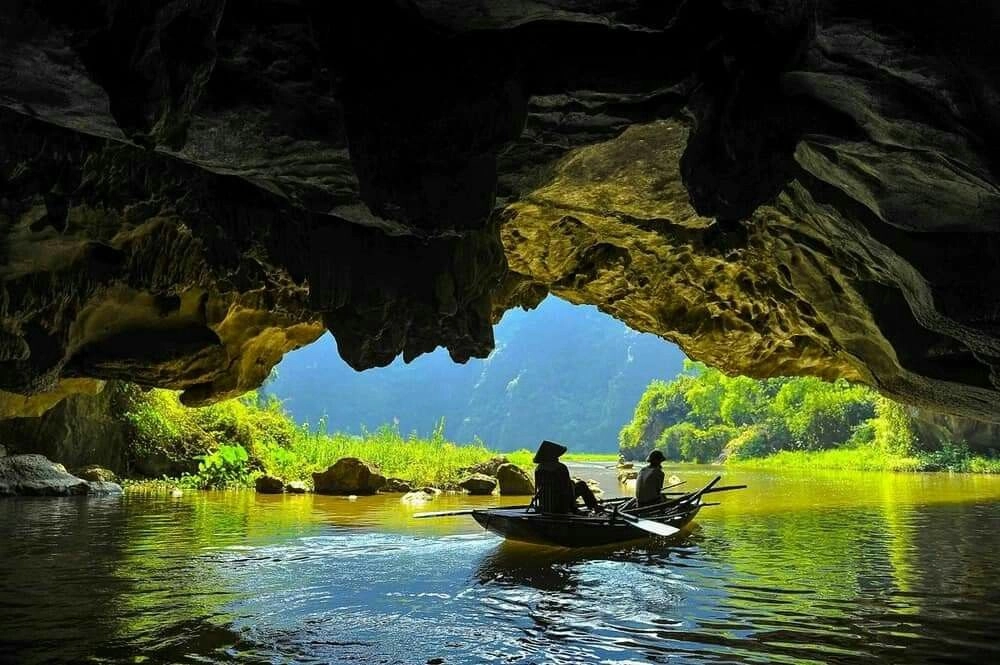
Early in the morning, before the mist leaves the ridgelines and the tour groups arrive, the water sits near mirror-flat, stacking reflections so cleanly that the boat seems to move through a second sky. That window closes fast in the spring festival months, when tour convoys from Hanoi start arriving mid-morning. Ninh Binh's own tourism figures make the pattern clear: the province logged about 15.99 million visits to its tourist sites in the first 5 months of 2026, with May alone at roughly 3.09 million, against about 983,000 in August. Tet through May is the crowded stretch; July to September is the quietest.
All three circuits cost the same: 300,000 VND (about USD 11.50) for adults over 1.3 m, 150,000 VND for children between 1 m and 1.3 m, free under 1 m, and 150,000 VND for visitors over 60. That one ticket covers a hand-rowed boat seating 4 to 5 passengers, the route you pick, and travel insurance. The complex runs 07:00 to 17:00 daily, and tickets stop selling in bad weather, so check before a storm. Tipping the rower at the end is customary, usually around 50,000 to 100,000 VND per boat rather than per person. The longer circuits push further into the quieter western reaches, away from the busiest piers, and are worth the extra time.
Hoa Lu Ancient Capital
Hoa Lu was Vietnam's political capital for roughly four decades, from the founding of the Dinh dynasty in 968 AD until the court moved north to Hanoi in 1010. The surrounding karst ridges did the defending, which made the valley easier to hold than any wall. Two reconstructed dynastic temples mark the site today: Dinh Tien Hoang, for the dynasty's founder, and Le Dai Hanh, for the ruler who repelled Chinese invasion before the court relocated.
For the full story of Hoa Lu's dynastic history, including the palace layout, the role of the site in consolidating Vietnam's independence, and what the archaeological record reveals about daily life in the 10th-century capital, our Hoa Lu Ancient Capital guide covers it in depth.
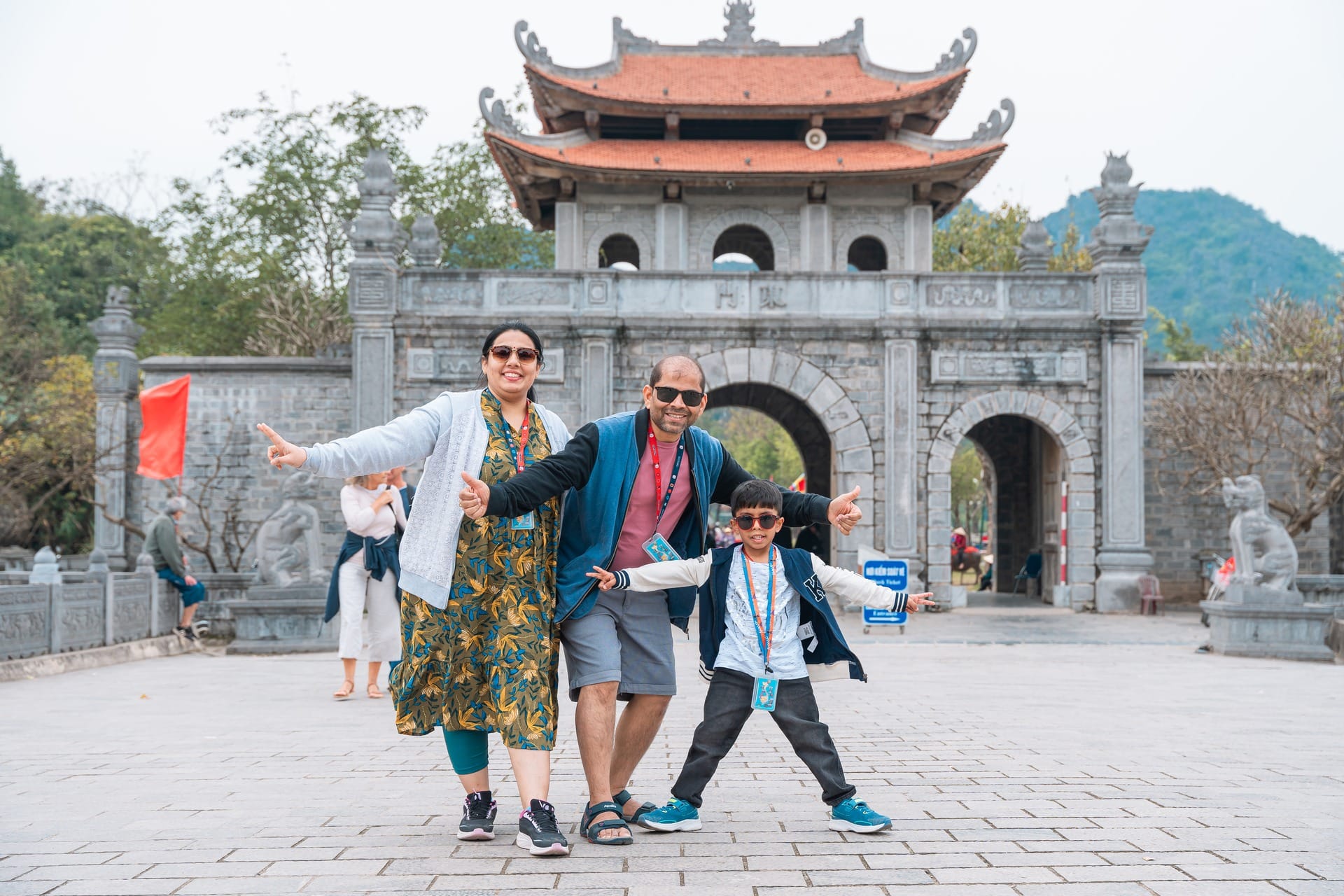
Our Hoa Lu, Trang An, and Mua Cave day tour combines all three stops in a single loop from Hanoi, with limousine transport, a guide, the boat trip and a buffet lunch.
Tam Coc - Rice Field Waterways
Tam Coc, "three caves" in Vietnamese, describes the three natural tunnels on the Ngo Dong River that you pass through during the rowing circuit. The landscape around Tam Coc is what most people picture when they imagine Ninh Binh: a flat plain of terraced rice paddies framed by abrupt limestone columns, with small wooden boats tracking slowly between them.

Rowing boats depart from Van Lam Pier on a 9 km out-and-back route. The total experience takes around 2 hours. Admission is 250,000 VND (about USD 9.50) per adult, or 350,000 VND (about USD 13.50) with the electric shuttle to the pier included; children between 1 m and 1.3 m pay 120,000 VND and 190,000 VND respectively. Tam Coc grows a single rice crop a year, not two: the paddies run bright emerald through spring, then turn gold from roughly mid-May to late June, and are cut by early July. An elderly woman rowing solo through a narrow channel between two fields, her conical hat balanced at the same angle as the limestone peaks above her, has become one of the defining images of this region.
The site draws significant visitor volumes mid-morning when organized tours from Hanoi arrive in parallel convoys. Starting before 7:30 am gives you calmer water, better light, and shorter queues at the ticket windows.
Bich Dong Pagoda is a short walk from Van Lam Pier and worth adding: three levels of prayer halls built into successive cave recesses in the cliff face, with the upper chamber opening onto a ridge-top view of the rice basin that is completely different in perspective from what you see at water level.
Van Long Nature Reserve - Wetland and Karst Wilderness
Van Long (also commonly written as Van Long Wetland Nature Reserve) is the largest intact lowland wetland in northern Vietnam and, on most days, one of the quietest corners of Ninh Binh. The reserve is reached by flat-bottomed rowing boat through a patchwork of flooded grassland and open water channels ringed on all sides by unbroken limestone ridgelines.
The experience is slower and more open than Trang An: fewer cave passages, more sky, and a stronger sense of being inside an undisturbed ecosystem. Van Long holds the largest known population of the Delacour's langur, a critically endangered primate found only in Vietnam and numbering an estimated 200-300 individuals worldwide. It is one of the few places in Vietnam where the langur can be seen from a boat with the naked eye, usually as family groups moving along the upper cliff faces.
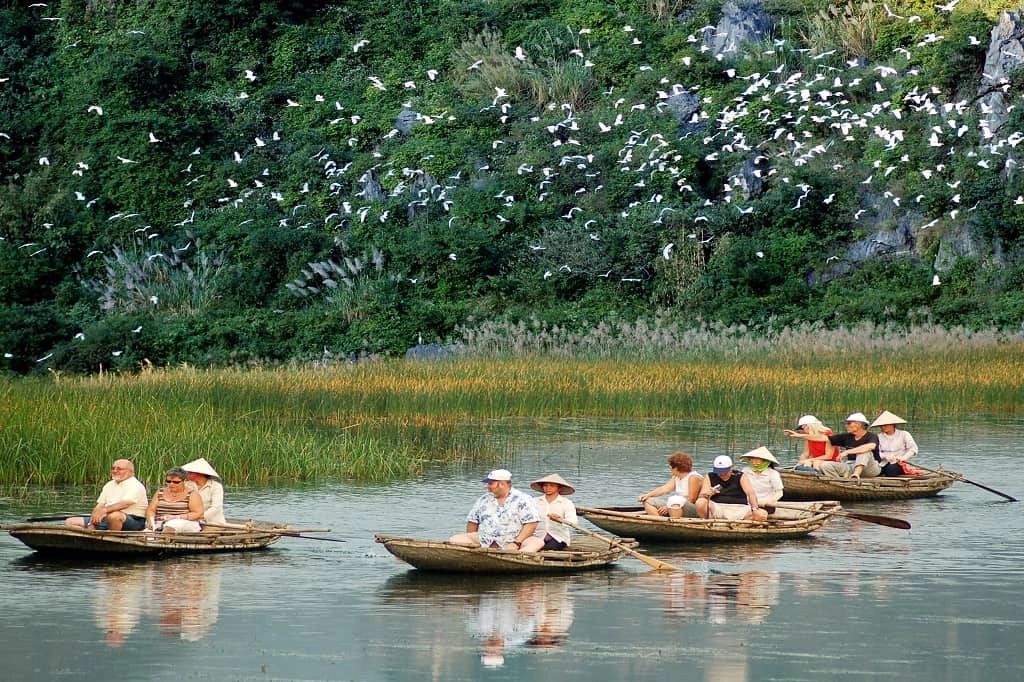
Wetland birding, karst silence and near-absent tourist infrastructure make Van Long a half-day add-on for visitors spending 2 or more nights, not a substitute for Trang An.
Mua Cave and Hang Mua Viewpoint
Hang Mua, usually called Mua Cave in English even though it works as a hilltop viewpoint rather than a cave system, is a rocky karst ascent ending at a ridge-top pavilion above the Tam Coc plain. The climb involves around 500 stone steps cut into the limestone face. A dragon sculpture marks the high point. Admission is 150,000 VND (about USD 5.75), and the site generally opens around 07:00 and closes at 18:00.
At the summit the view reverses your boat-level experience: you look down over the same paddy basin and limestone columns you rowed through, from roughly 100 meters above the valley floor. Late afternoon in the weeks before the harvest, roughly late May to late June, is when it is at its best, with low western light turning the terraces from amber to pale gold.
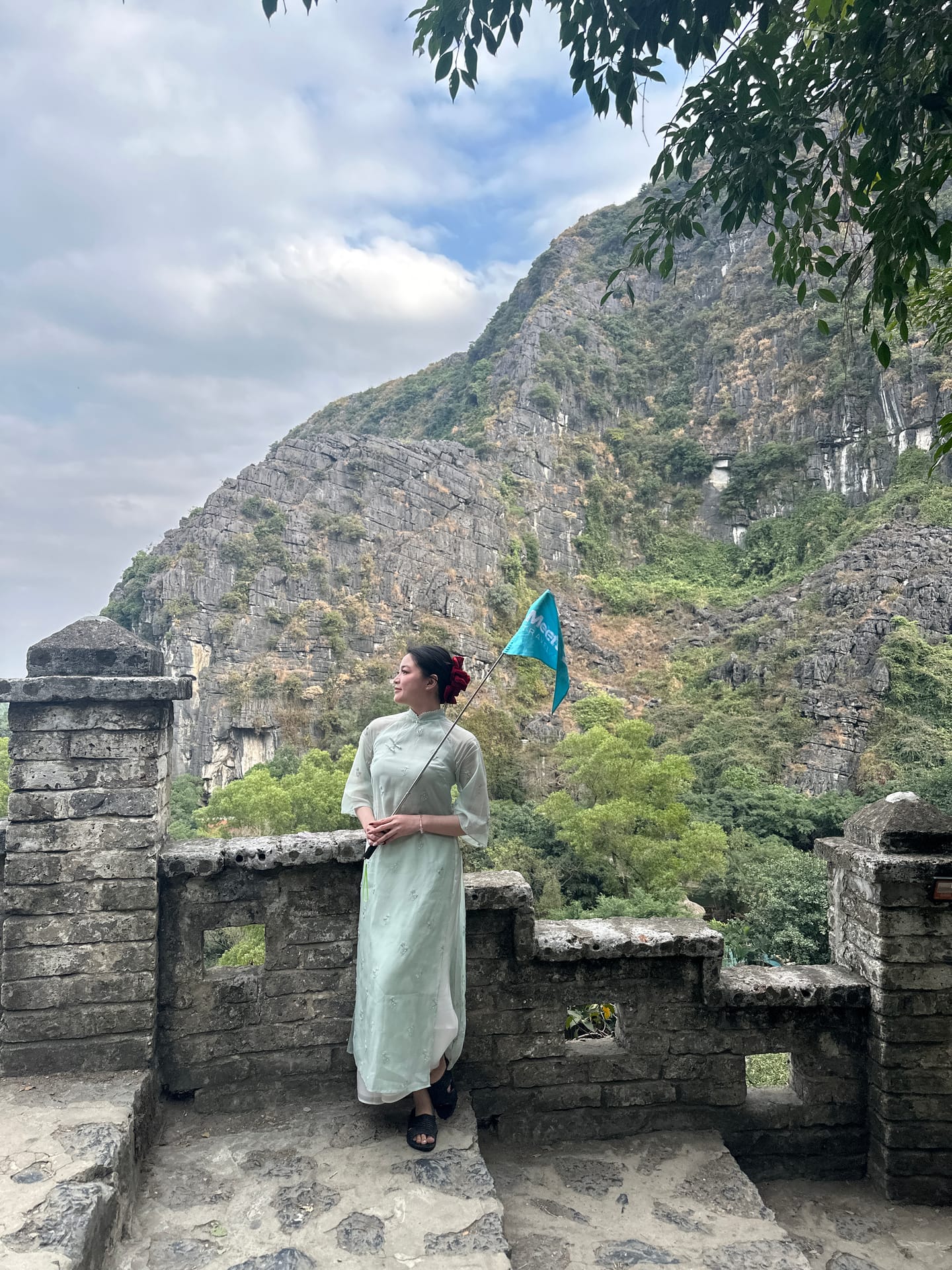
The climb takes 15 to 25 minutes; the descent needs care on wet stone. Mua Cave pairs with Tam Coc in the same half-day, the two being within cycling distance.
Bai Dinh Pagoda - Scale and Contemporary Buddhist Practice
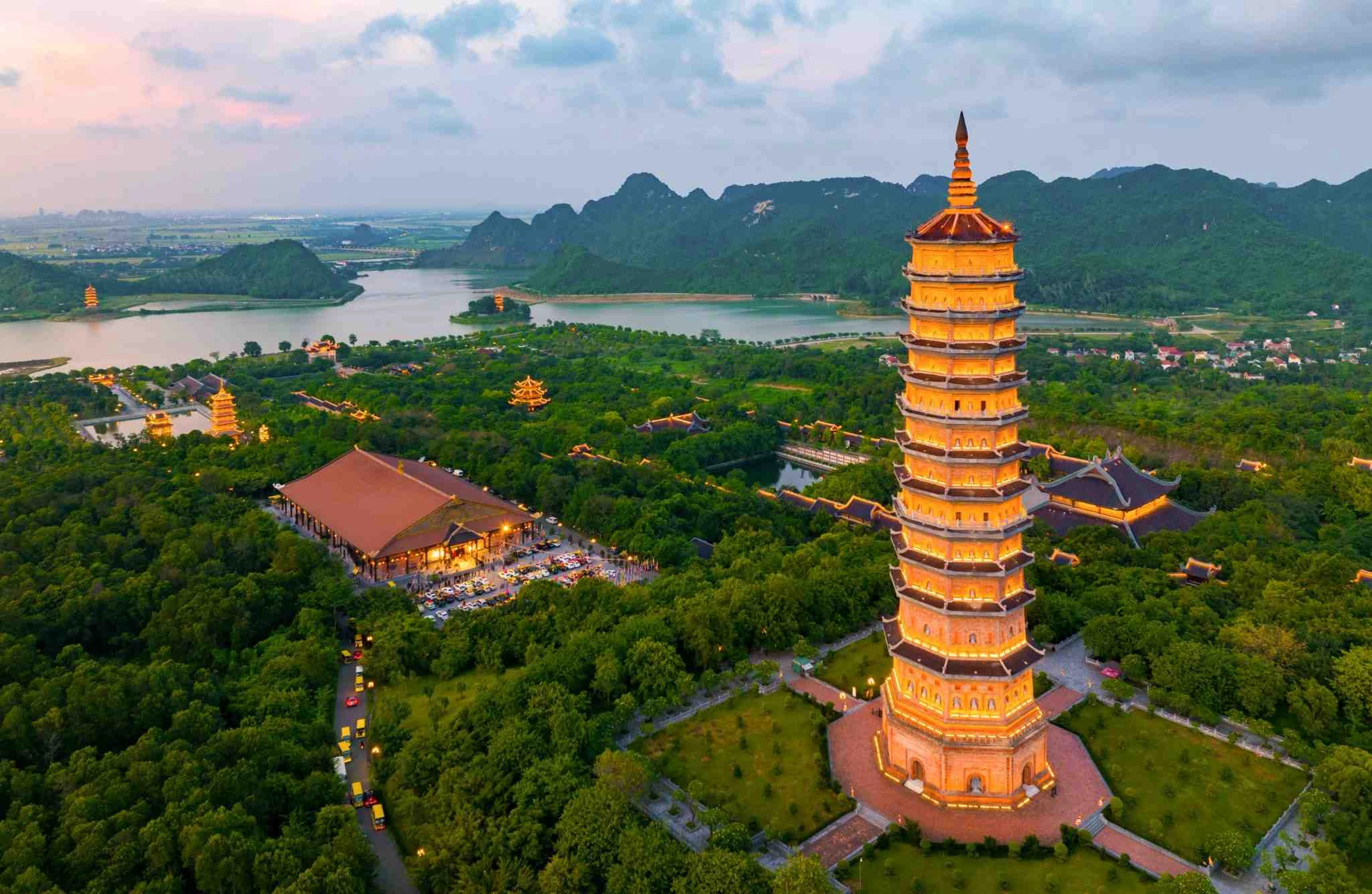
Bai Dinh is a contemporary Buddhist complex built from the mid-2000s on the western edge of the province, and it trades on scale: a 100-ton, 10-meter bronze Sakyamuni statue, an arhat corridor running close to 3 km with 500 carved stone figures, and a 36-ton bronze bell.
Entry to the pagoda grounds is free. What you pay for are the add-ons: the electric shuttle between the car park and the main complex costs 60,000 VND return or 30,000 VND one way, and climbing the Bao Thien stupa costs 50,000 VND. The complex is open roughly 06:00 to 18:00, and the walk from the gate to the far end of the arhat corridors is long enough that most visitors take the shuttle at least one way. Visiting is less about ancient history than about Vietnamese Buddhism as a living practice: pilgrimage groups from across northern Vietnam come year-round, and the bell carries a long way on clear mornings.
Bai Dinh pairs naturally with Trang An as a 2-day Ninh Binh itinerary: one day at the pagoda and on the water at Trang An, the next spent cycling through the villages, visiting Hoa Lu, and boating through Tam Coc. Our 2-day, 1-night Ninh Binh program structures this combination as a guided overnight itinerary from Hanoi, with an overnight stay at Trang An Heritage Garden, transport, meals, the boat trips and a guide.
Getting There from Hanoi
Ninh Binh is about 90 km south of Hanoi, around 1.5 to 2 hours by road. Most visitors come by limousine van, private car or an organized day tour with hotel pickup.
For prices, travel times and which option fits your trip, read our Ninh Binh day trip from Hanoi guide.

If you'd rather not coordinate a driver, hotel pickup times, and boat bookings separately, our Hoa Lu, Trang An, and Mua Cave day tour handles round-trip limousine transport from Hanoi, a guide, the boat trip and lunch in one fixed-departure itinerary - a straightforward option if this is your first visit.
Getting from Ninh Binh to Ha Long Bay
Ninh Binh and Ha Long Bay are both in northern Vietnam but are not adjacent: the most direct route passes back through or around Hanoi's eastern orbital roads before heading northeast toward the bay. Total journey time by private transfer or organized tour van runs 4 to 5 hours.
There is no direct public bus or train route connecting Ninh Binh to Ha Long Bay without a Hanoi transfer. Travelers on a northern loop (Hanoi, Ninh Binh overnight, then Ha Long cruise) typically book a transfer that picks up from Ninh Binh and connects to a Ha Long Bay cruise departure point at Tuan Chau Marina or Hon Gai.
The two destinations complement each other well on the same trip: Ninh Binh delivers the inland karst and dynastic history that Ha Long Bay does not offer, while Ha Long provides the overnight cruise experience on open water that is impossible to replicate on Ninh Binh's river system.
Where to Stay in Ninh Binh
Accommodation in Ninh Binh concentrates in two zones that suit different trip styles.
The city center, now part of Hoa Lu city - Ninh Binh City merged into Hoa Lu city on 1 January 2025, so signage and booking sites still use either name. This area has the train station, the bus connections, and the widest choice of mid-range hotels. Practical if you arrive by train or move on early the next morning.
Tam Coc - Trang An area - The guesthouses around Van Lam village and the Tam Coc pier road sit within cycling distance of the boat piers, Mua Cave, and Bich Dong Pagoda. Staying here drops the morning minibus leg and gets you to the piers ahead of the group tours. Most visitors who spend 2 nights choose this area.
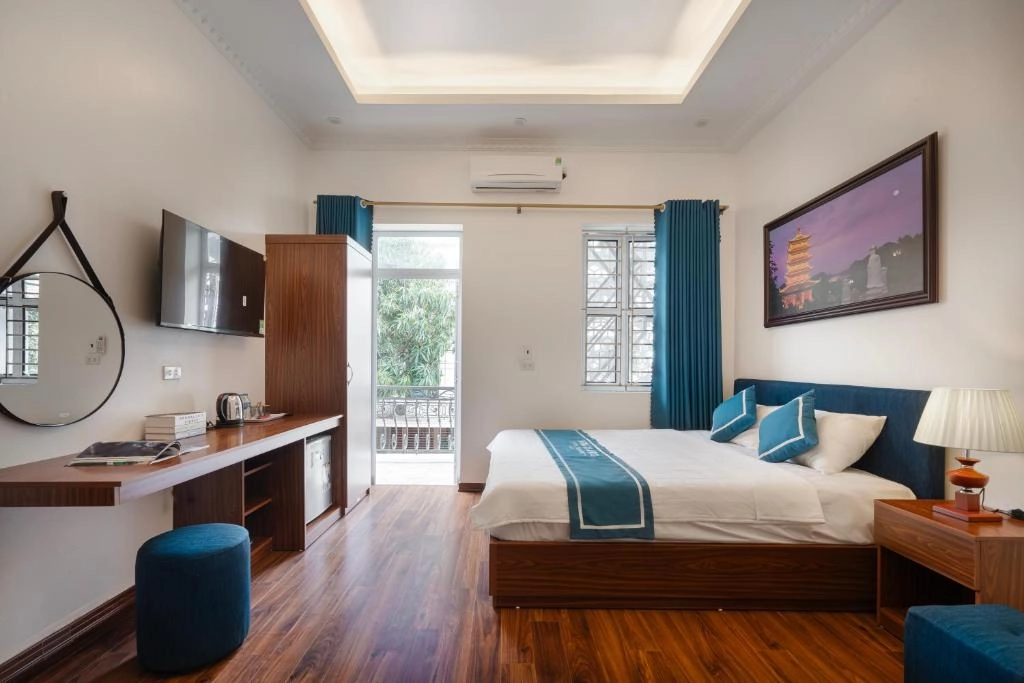
A handful of properties across the Tam Coc, Trang An, and Hang Mua corridors have become traveler defaults, mostly for being close to the piers and for pools set against karst walls:
Tam Coc Rocky Bungalow - central Tam Coc, an 8-minute walk from Bich Dong Pagoda. Ten cottages face the pool with limestone peaks directly behind. Suits couples.
Tam Coc Bungalow (Van Lam village) - infinity pool with a sheer karst wall behind it, walking distance to Van Lam Pier.
Trang An Valley Bungalow - Trang An side, pool split into adult and children sections. Good pick for families.
Trang An Ecorest Resort & Spa - resort tier in the Trang An area, mountain-view rooms, larger pool and full spa.
Chez Beo Homestay (Hang Mua area) - bungalows tucked into the karst, about 1 km from Hang Mua and 3 km from Tam Coc. No pool, but rice fields on three sides and cliffs on the fourth. Book the private bungalows, not the shared house.
Prices for a double room with breakfast in this zone run roughly 400,000-1,500,000 VND a night (about USD 15 to 57), depending on tier: budget bungalows at the lower end, resort-style properties like Ecorest at the upper end. Rates differ between booking channels, so compare the online travel agency listing against the property's own Facebook page or Zalo number before you book.
Renting a bicycle from your guesthouse for around 30,000-60,000 VND a day is the standard way to move between attractions in the Tam Coc zone, covering Bich Dong Pagoda, Mua Cave, and the surrounding rice field roads at your own pace.

Checked 14 September 2026. Admission prices for Trang An, Tam Coc and Hang Mua come from the Trang An Scenic Landscape Complex management board; Bai Dinh service charges and opening hours from operator listings; visitor numbers from Ninh Binh Department of Tourism releases. Room, bicycle and transfer prices are indicative ranges rather than fixed rates. Dong amounts convert at about 26,100 VND to the US dollar.
Looking to visit Ninh Binh without managing boat bookings, entrance fees, and transport logistics yourself? Browse Meetup Travel's full range of day tours and overnight programs to find the format that fits your trip.