
Vietnamese Travel Agency: Verify Before You Pay (2026)
The first thing I check when a traveler forwards me an agency quote is not the price. It is whether the agency listed a license number in the email. A legitimate Vietnamese travel agency knows that number by heart. The ones I have watched vanish on people found excuses.
A Vietnamese travel agency, chosen well, replaces two weeks of research with a single conversation. It also knows which coastal road is under repair, which cave permit closed last month, and which restaurant will actually be open when your group arrives at 7 pm. The problem is not that these agencies do not exist. The problem is that they share search results with laminated-menu operations, AI-built websites, and cash-only desks that fold the week you land.
This is not a sales page. It is the verification process I run on every operator before I recommend one, and the five-minute check I wish every international visitor did before sending a deposit. If you follow the sequence below, you will filter out the bottom third of the market before you pay anyone anything.

Checking a Vietnamese travel agency before paying a deposit
What Legally Counts as a Vietnamese Travel Agency
The Vietnamese phrase "travel agency" translates loosely and covers three very different legal categories. Understanding which category you are looking at determines whether you are protected by law or by hope.
Under Article 31 of the Law on Tourism 2017, with the detail set out in Decree 168/2017/ND-CP and Circular 06/2017/TT-BVHTTDL, an agency that sells tours to foreign visitors must hold an International Tour Operator License issued by the Vietnam National Authority of Tourism, known as VNAT. A domestic-only license does not cover you. If you are an international visitor and the agency holds only a domestic license, the transaction sits outside the international-tourism regulatory framework entirely.
To obtain the international license, the agency must maintain a bank deposit of 250 million VND (~9,500 USD at 2026 rates) for inbound tours only, or 500 million VND if it also runs outbound tours, under Article 14 of Decree 168/2017/ND-CP. This deposit is not a fee, it is a security reserve held at a Vietnamese commercial bank for the lifetime of the business, and it exists to compensate travellers if the company breaches its contract, per the deposit rules confirmed by Viet An Law. The agency's head of travel operations must also hold a college degree or higher in tourism, or a certificate in international tour operation. These conditions are what the street-level operations advertising "tours for foreigners" in Hanoi's Old Quarter and Ho Chi Minh City's Pham Ngu Lao area typically cannot meet.

Licensed travel agency office in Vietnam
The Three Categories You Will Encounter
For a foreign visitor comparing options online, the practical categories are:
Category | Legal status | Typical channel | Your recourse if it fails |
|---|---|---|---|
VNAT-licensed international tour operator | Fully regulated, deposit on file, licensed guides | Own website, direct booking, TripAdvisor top-listed | VNAT complaint, deposit-backed refund |
Unlicensed reseller / booking desk | Resells seats from licensed operators, no direct accountability | Guesthouse counters, sidewalk stands, Facebook pages | WhatsApp argument only |
International OTA (Klook, Viator, GetYourGuide) | Not a Vietnamese agency; a platform that resells them | App or web platform | Platform-enforced refund |
The middle row is where most scam money is lost. If a booking counter in a hostel reception cannot produce the license number of the operator running the tour, you are in the middle row whether the salesperson uses the word "agency" or not.
The Five-Minute Verification Process
Every legitimate Vietnamese travel agency clears this check. The unreliable ones fail at step one or two. It takes five minutes if you know where to click.
Step 1 - Get the License Number in Writing
Ask, in your first email or WhatsApp message: "Please share your International Tour Operator License number issued by VNAT." A licensed agency responds within one message with a code that looks like 01-3163/2026/CDLQGVN-GP LHQT (a two-digit province code, a serial, a year, and the "LHQT" international-scope suffix). The CDLQGVN segment stands for Cục Du lịch Quốc gia Việt Nam, the current name of the Vietnam National Authority of Tourism. Older licenses issued before the 2023 reorganization use the TCDL-GP LHQT suffix instead, and both remain valid, but any license issued from 2023 onward should carry the CDLQGVN marker. If the reply is "we are a registered company, please see our website," you are already outside the licensed pool. Legitimate agencies name the number the same way a doctor names a medical license. Hesitation is the signal.
Step 2 - Verify on the VNAT Travel Business Registry
Open the registry at quanlyluhanh.vn, the travel business database operated by the Vietnam National Authority of Tourism and reachable from the national tourism data portal at csdl.vietnamtourism.gov.vn. Search by company name or license number, and filter by province and by scope of operation. A valid record returns the Vietnamese and English company names, the license number, the registered head office address, and the licensed scope (inbound, outbound, or both). If the record does not return, the license is either fake or issued only for domestic tours. Either answer is a stop signal for an international visitor.

Verifying a tour licence on the VNAT travel business registry
Step 3 - Cross-Check the Tax Number
The tax code, called MST in Vietnamese, appears on every legitimate agency invoice. It can be looked up on the tax authority's public lookup portal at tracuunnt.gdt.gov.vn. The name and address on the MST record should match the VNAT record exactly. A mismatch is not necessarily fraud, but it means the operating company and the licensed entity may be two different things, and your legal recourse in a dispute becomes murky.
Step 4 - Review Two Platforms, Not One
TripAdvisor alone is no longer sufficient as a trust signal. According to TripAdvisor's Transparency Report 2025, covering 2024 and reported by Vietnam.vn, more than a third of all paid fake reviews detected globally originated in Vietnam and Indonesia, which puts Vietnam second in the world on that measure. Around 8 percent of all reviews submitted to the platform in 2024 were judged fake. Look for consistent reviews across TripAdvisor and Google Reviews. A 4.9 on TripAdvisor combined with a 3.7 on Google is the signature of selective review management. The Google score is the harder one to game and the more honest one to read.
Step 5 - Payment Method as a Final Filter
A licensed operator accepts card payment, bank transfer with an invoice, or a mix of deposit-by-transfer plus balance on arrival. A cash-only demand with no card option, especially for the full amount before departure, has no dispute mechanism attached. If your tour does not arrive, a bank can reverse a card. Cash cannot be reversed, and a cash payment leaves you with no counterparty to escalate to.
Red Flags and Scam Patterns From 2026
The scam formats have evolved. The signals have not. Four patterns come up again and again in traveller complaints about Vietnamese agencies, and all four are visible before you pay.
Pattern 1 - The 40-percent underquote. An operator lists a Mekong Delta day trip at $22 when the market band is $35 to $55. The gap does not come from local efficiency. It comes from removing the entry fees (~120,000 VND at Cu Chi for foreign visitors, 40,000 VND at the War Remnants Museum, per the current official rates), the licensed guide, or the small-group vehicle. What you receive is a 40-person minibus, a driver with a spare hat, and a demand for cash at the ticket gate. The tour technically happens. The tour you paid for does not.
Pattern 2 - WhatsApp silence after the deposit. The pre-payment communication is fast and helpful. Within an hour of the deposit clearing, the response time stretches to 12 hours, then 24, then goes dark until the day before the tour. The last message reads: "everything ready, please be at hotel lobby 7:15." No confirmation of guide name, vehicle, or included meals. Two possible outcomes follow. Either a real tour arrives and is mediocre, or nothing arrives and the WhatsApp number is deactivated by Monday.

Meetup Travel and our lovely travelers in Vietnam
Pattern 3 - Itinerary swap post-payment. Three days before departure, a message arrives: "we upgraded your hotel to a partner property, same category." The partner property is a 2-star with an aspirational name. Or: "the route has been slightly adjusted for traffic, you will now spend less time at Hoi An Ancient Town." This is a cost-cut disguised as service. A licensed agency documents any change and gets written approval, because the original itinerary is what your deposit legally covers.
Pattern 4 - The mismatch between website polish and reply quality. An AI-built website with slick photos and confident copy, followed by broken-sentence replies and vague pricing. The website and the operation are not built by the same people. A template site can be bought for a few hundred dollars and reskinned under a new company name in a week. The template is bought, the business is not.
Spotting Fake TripAdvisor Reviews
TripAdvisor's fraud team classifies fake reviews into four categories: review boosting (paid positive reviews), vandalism (paid negative reviews against competitors), member fraud, and organized paid networks. Repeat offenders receive a red warning label on their listing page. When you land on an operator page, scroll to the bottom - the presence of a red penalty banner is the fastest disqualifier available. Beyond that, three quick signals: check whether reviewers have more than one review on their account (single-review accounts are the strongest fake-review indicator), look for reviews clustered within a short date range (a wave of five-star reviews in a two-week window is a signature of a paid campaign), and read the negative reviews first - the balance and specificity of one-star reviews reveals whether the operator responds honestly to problems.
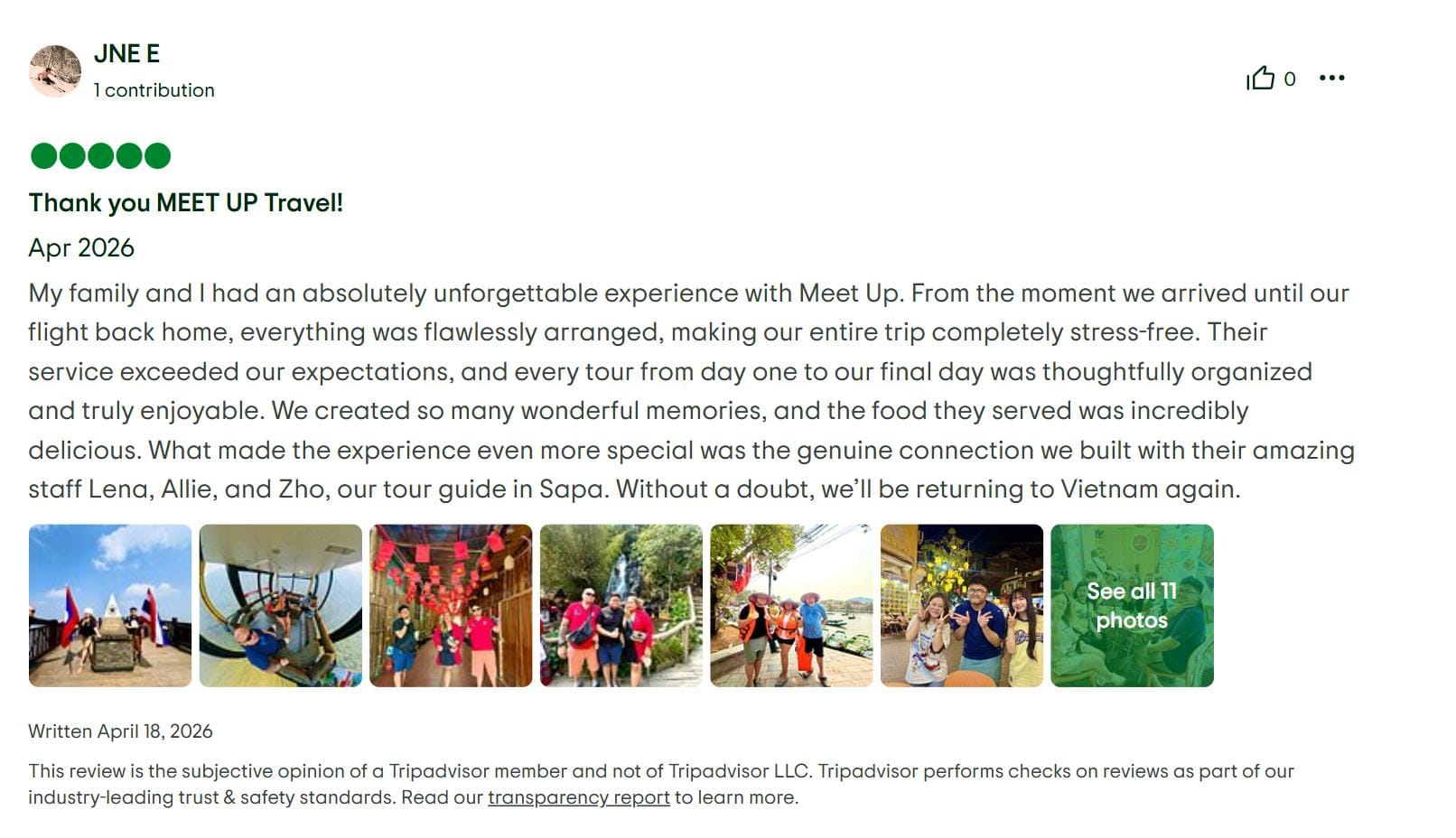
Reading TripAdvisor reviews for a Vietnamese tour operator
Local Vietnamese Agency vs Klook, Viator, and OTAs
Once you know how to verify, the choice between booking a local Vietnamese travel agency directly or going through an international platform becomes a straight cost-versus-protection calculation.
Book direct with a verified local agency when: you want a multi-day custom itinerary, you are traveling as a group of three or more, you have run the five-step verification, and you want the local price without the OTA commission layer. Direct bookings typically run 15 to 30 percent below Klook and Viator for the identical product, because the platforms take a 10 to 30 percent commission on top of the operator's price.
Book through Klook, Viator, or GetYourGuide when: you are on a short trip with no time to vet operators, you want the enforceable refund of a platform in case of no-show, or you are booking a single day tour where the price gap is small. The platform premium buys you dispute enforcement. It is worth paying for on your first Vietnam tour and worth optimizing away once you have found operators you trust.
Special case - Ha Long Bay cruises. Budget Ha Long Bay cruises are the category where the gap between the brochure and the boat shows up most often. On a multi-hour cruise where you cannot walk off, the OTA buyer protection is worth the markup regardless of your verification skill.
For a fuller breakdown of licensed operators by market positioning and price band, see the best Vietnam tour companies guide, which compares the specific players in the licensed-and-established tier.

Booking a local Vietnamese agency compared with an OTA platform
Questions to Ask Before You Pay a Deposit
The pre-deposit conversation should feel like a short interview, not a sales call. If any of the answers below take more than one exchange to get, treat that as data.
What is your VNAT International Tour Operator License number? One-message answer. Verifiable.
Can you send me the itemized itinerary in a PDF, including all entry fees, meals, transfers, and guide language? Legitimate operators have this document ready. Screenshots are not documents.
What is your bank deposit account name, and can I pay by card or transfer with an invoice? The account name should match the licensed company name on the VNAT record. Any personal account name is a red flag.
Who is my assigned guide and can I have their name in advance? Licensed guides have license cards. Reputable agencies confirm the guide name and language at booking, not on the morning of the tour.
What is your refund policy if the tour is cancelled by you or by weather? The answer should be written into the itinerary PDF, not improvised.
What insurance is included in the price? Article 37 of the Law on Tourism 2017 requires every licensed operator to insure travellers for the duration of the tour, unless the traveller already holds cover for the whole programme. Ask which provider underwrites it and what the coverage limit is, and get both in writing.

Questions to ask a Vietnamese travel agency before paying
Practical Summary: What the Verified Path Looks Like
The layer below is written for reference. Screenshot it and keep it open when you compare operators.
License to require: International Tour Operator License, VNAT-issued, under Article 31 of the Law on Tourism 2017
Deposit reserve held by agency: 250 million VND (inbound only) or 500 million VND (inbound + outbound), at a Vietnamese commercial bank, per Decree 168/2017/ND-CP
Head of travel operations: college degree or higher in tourism, or an international tour operation certificate
Verification portal: quanlyluhanh.vn (search by company name or license number)
Market rate benchmarks (2026): half-day city tour 18-28 USD per person, Mekong Delta day trip 35-55 USD per person, mid-range multi-day private tour 65-150 USD per person per day
Payment methods that protect you: card, bank transfer with invoice, deposit-plus-arrival split. Never cash-only for the full amount.
Direct VNAT contact for license queries: [email protected] or +84 24 3944 7571
The pattern that separates the reliable Vietnamese travel agency from the rest is not marketing polish. It is the willingness to answer three basic questions - license number, itinerary in writing, payment by card - before asking for money. If those three answers come easily in the first exchange, you are talking to the right kind of operator.
If the logistics you want are specifically Southern Vietnam and Ho Chi Minh City based - Cu Chi Tunnels, Mekong Delta homestays, Con Dao, Phu Quoc, day trips out to Tay Ninh or Vung Tau - Meetup Travel (MEETUP TRAVEL SOLUTIONS COMPANY LIMITED, International Tour Operator License 01-3163/2026/CDLQGVN-GP LHQT, issued by the Vietnam National Authority of Tourism) handles the itinerary planning with a written PDF quote inside 24 hours, card and bank transfer accepted, VNAT license number and guide names on every booking, and complimentary travel insurance included on every package.
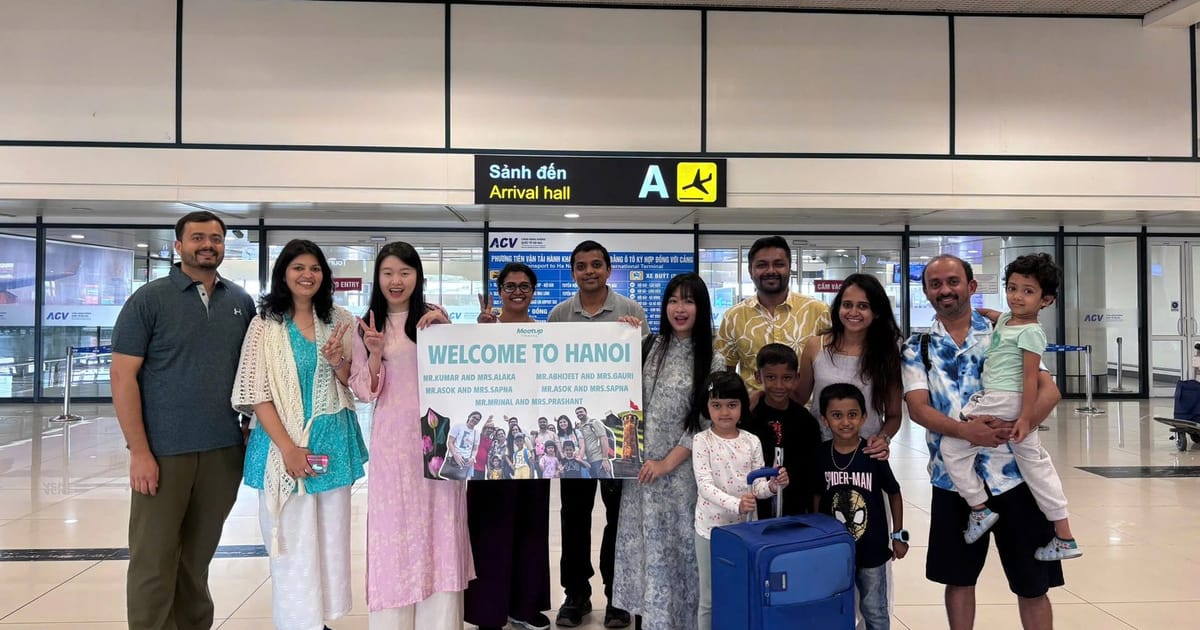
Meetup Travel office and licensed booking process in Vietnam
Offices in Hanoi (16th Floor, Building C1 Thanh Cong, Giang Vo Ward) and Ho Chi Minh City (53 Pho Duc Chinh Street, Ben Thanh Ward). Reviews and traveler feedback are on the Meetup Travel TripAdvisor page: Meetup Travel - All You SHOULD Know Before Going 2026 (with Reviews). No deposit required until the itinerary is signed off. That is not a sales pitch. It is the same standard this article says every operator should meet, applied to the one I know from the inside.
Frequently Asked Questions
How do I verify a Vietnamese travel agency is legitimate? Verify a Vietnamese travel agency in five minutes by searching its International Tour Operator License number on the official VNAT travel business registry at quanlyluhanh.vn. A legitimate agency provides the number in the first inquiry message and it looks like "01-3163/2026/CDLQGVN-GP LHQT" - the LHQT suffix indicates international scope, and CDLQGVN identifies the current issuing authority (Cục Du lịch Quốc gia Việt Nam). Older valid licenses may still show the TCDL suffix from before the 2023 authority reorganization. Cross-check the company name against the tax authority's public lookup portal, then confirm consistent reviews on both TripAdvisor and Google. If any of these three checks fail, walk away before you send a deposit.
What license does a Vietnamese travel agency need to serve foreign tourists? A Vietnamese travel agency serving foreign tourists must hold an International Tour Operator License issued by VNAT under Article 31 of the Law on Tourism 2017. The agency maintains a bank deposit of 250 million VND for inbound tourism only or 500 million VND if it also runs outbound tours, under Decree 168/2017/ND-CP, and its head of travel operations must hold a college degree or higher in tourism or a certificate in international tour operation. A domestic license is not enough. Any operator selling tours to international visitors without the international-scope license is operating outside the regulatory framework designed to protect you.
Is it safer to book a Vietnam tour through Klook or a local Vietnamese agency? Klook and other OTAs offer stronger dispute enforcement, but prices run 15 to 30 percent higher than direct bookings with the licensed operator. A verified VNAT-licensed local Vietnamese agency paid by card is safe and cheaper, because the platform commission does not apply. A cash-only local desk with no verifiable license is the highest-risk option regardless of price. The right answer depends on whether you have time to verify: book on Klook for the first tour, book direct once you have an operator you trust.
What are the biggest red flags of a Vietnamese travel agency scam? Four red flags recur across nearly every documented case. First, cash-only payment demanded up front. Second, refusal or delay when you ask for the International Tour Operator License number. Third, prices 40 to 50 percent below the market rate for the same route. Fourth, WhatsApp response times that lengthen sharply after the deposit clears. Any single one is a warning; two or more is a stop signal. The specific pattern to watch for is a polished website followed by broken-sentence replies, because that combination is often a template site rented over a shell business.
How much does a legitimate Vietnamese travel agency charge in 2026? A legitimate Vietnamese travel agency in 2026 charges roughly 18 to 28 USD per person for a half-day city tour in Ho Chi Minh City or Hanoi, 35 to 55 USD for a Mekong Delta day trip from HCMC, and 65 to 150 USD per person per day for a mid-range multi-day private itinerary with hotels, guides, and domestic transfers included. Luxury tailor-made itineraries run 200 to 400 USD per person per day. Quotes 40 percent below these bands are not efficient pricing - they are the price with the entry fees, insurance, or guide qualification removed.
The verification is the tour. Fifteen minutes of checking a license number, cross-referencing two review platforms, and reading a payment page carefully is the difference between a week that works and a week you spend arguing with a WhatsApp account. The Vietnamese travel agency you want to book with will make this check easy, because they built the business to pass it.