
Son Doong Cave Expedition: Cost, Permits, and Fitness
Son Doong is the largest known cave passage on the planet, and you cannot walk in off the street. One licensed operator runs it, 1,000 people a year get inside, the price is US$3,000, and the trip takes six days and five nights, three of them sleeping in tents inside caves.
Two facts matter before anything else. First, Oxalis currently lists the 2027 Son Doong Expedition as fully booked. If your dates are fixed, this trip is probably not the one you are taking. Second, the fitness bar is a published, enforced set of numbers, not a suggestion, and Oxalis will send people home partway through without a refund.
This guide covers the money, the actual six days, the fitness rules, and what to book instead.
Quick Facts
Item | Detail |
|---|---|
Location | Phong Nha-Ke Bang National Park, Quang Tri province (formerly Quang Binh) |
Discovered | 1990 by Ho Khanh, a local forest man, who lost the entrance and found it again in 2008 |
Surveyed | Entered in 2009 by the British-Vietnam Caving Expedition Team led by Howard Limbert; full survey completed 17 March 2010 |
Size | Nearly 9 km long, sections up to 200 m high and around 160 m wide, volume 38.5 million m³ |
Operating licence | Exclusive to Oxalis Adventure since August 2013 |
Permits per year | 1,000, capped by the national park |
Season | January to the end of August; closed September to December |
Trip length | 6 days, 5 nights, with 3 nights camping inside caves |
Price | US$3,000 per person, listed as VND 80,000,000 |
Group size | Maximum 10 guests, supported by around 30 staff |
Age limit | 18 to 70 |
Difficulty | Oxalis level 6 of 6 |
Why Only One Company Runs Son Doong
Son Doong is not an attraction that operators bid on. It is a single licensed concession, held by Oxalis Adventure since the cave opened to paying visitors in August 2013.
The arrangement was set up with the provincial People's Committee and the national park management board, on the reasoning that a fragile cave with a fixed carrying capacity is better run by one accountable operator than fought over by many. Oxalis works with the British caving team that surveyed the cave, employs local porters and safety staff at scale, and reports to the park on every departure.
The consequence for you is simple. If a website offers a cheaper Son Doong trip that is not routed through Oxalis, either you are being sold the two-day Hang En trek under the wrong name, or you are being scammed.
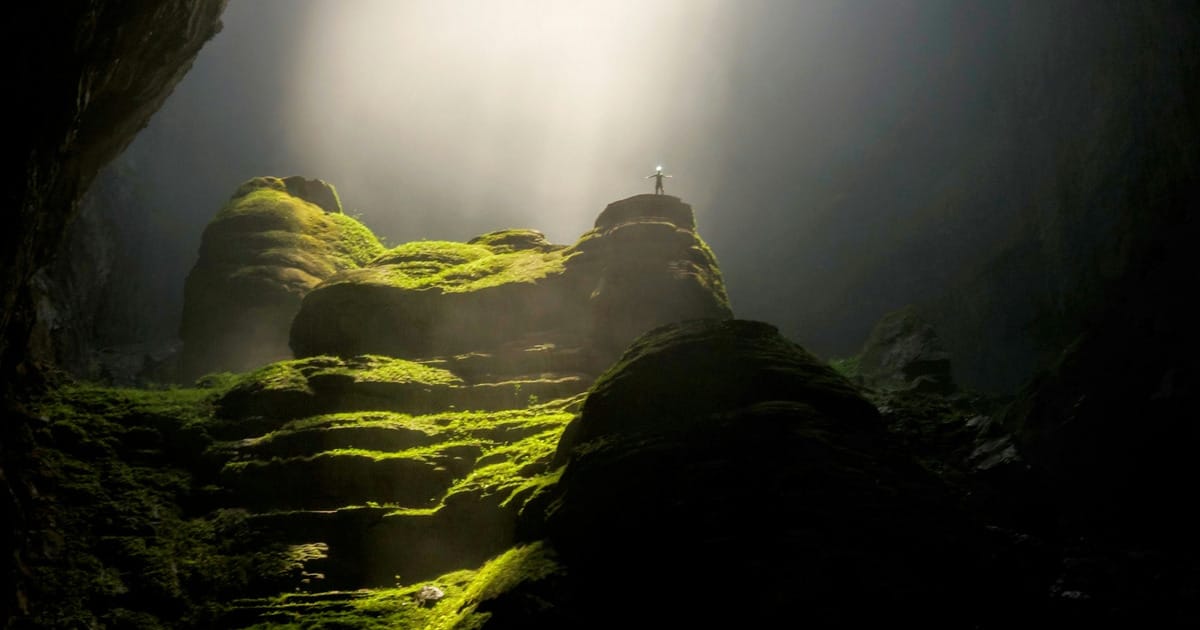
Expedition team at the entrance to Son Doong Cave
What the US$3,000 Actually Covers
Oxalis lists US$3,000, or VND 80,000,000, and publishes the breakdown rather than leaving it vague.
Included:
US$600 in entrance and environmental service fees, plus US$20 in park management and supervision fees
The full team: 1 cave expert, 1 tour guide, 6 safety assistants, 2 chefs and around 18 porters for a group of 10
All caving and safety equipment, camping gear, water bottle and purifier, and the composting toilet system
All meals and drinks on the fixed menu
Five nights of accommodation: the first at Commander Lodge in Phong Nha, three in tents inside the caves, the last at Chay Lap Farmstay
Pick-up and drop-off anywhere in Dong Hoi
Basic travel insurance as required by Vietnamese tourism law, capped at 50 million VND per case
Not included:
Flights to Dong Hoi and any nights either side of the trip
Vietnam visa
Comprehensive travel insurance with adventure caving cover. Oxalis provides the legal minimum and explicitly recommends you buy your own on top. Do that.
Payment and cancellation. You pay 100% at booking, not a deposit. Cancel more than 90 days out and you are refunded in full minus a 7 million VND booking fee. Cancel inside 90 days and you lose 50%. Cancel inside 45 days and you lose the lot.
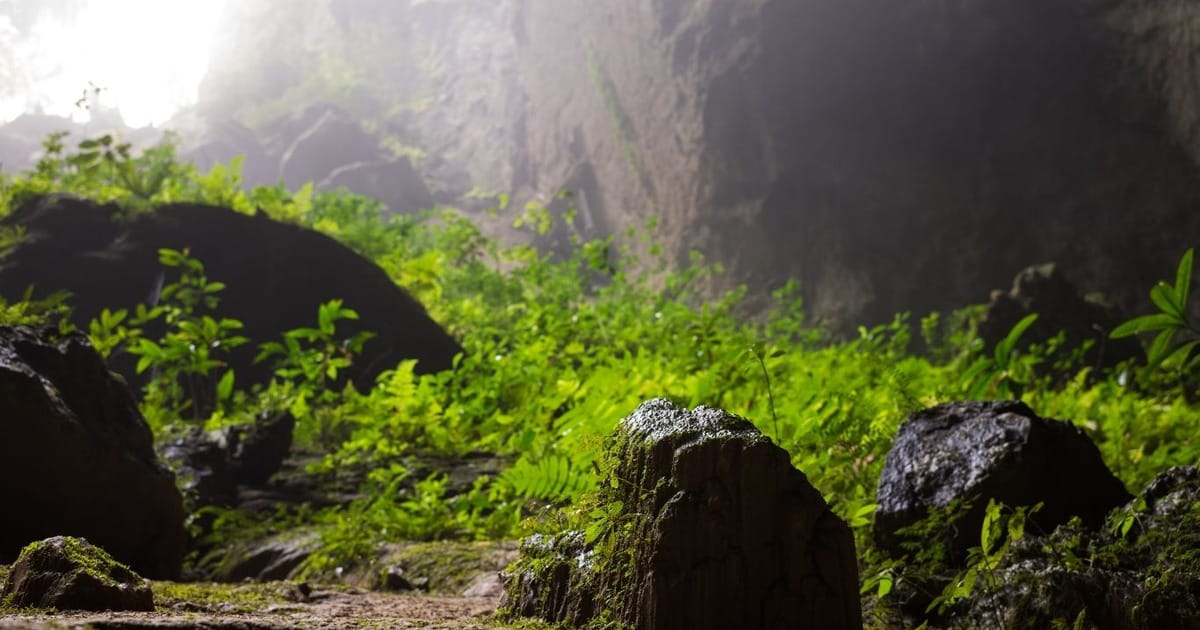
Sunlight filtering through the sinkhole, nurturing a subterranean forest
The Six Days, in Outline
Treat this as the shape of the trip, not a schedule. Oxalis publishes the full daily breakdown and revises it, and weather changes the running order.
Day | Where you go |
|---|---|
Day 1 | Arrive Dong Hoi, transfer to Phong Nha, safety briefing and kit check |
Day 2 | Jungle descent, Ban Doong village, trek on to Hang En |
Day 3 | Hang En out to the Son Doong entrance, descend into the cave |
Day 4 | Doline 1, the Wedding Cake stalagmite, the Garden of Edam |
Day 5 | The Great Wall of Vietnam, out of the cave, back to the road |
Day 6 | Return to Dong Hoi |
Three things about that shape are worth knowing before you book.
Day 1 is a filter, not a rest day. The safety briefing is compulsory and you can be refused the trip for missing it. You bring your shoes and pack for a check by a safety expert, and you sign a release and a medical declaration.
Day 2 is where people get sent home. Oxalis states that a guest who cannot finish the first trekking day, or who only finishes it with heavy support, goes back to Phong Nha with no refund. The route through the cave is one-way, so there is no easy exit after that.
Day 5 is the hard day. The Great Wall of Vietnam is a 90 m calcite barrier at the far end of the cave: a steel ladder, then rope work, then a long slope at 45 degrees, clipped to a safety line the whole way. It is not technical climbing. It is relentless, and it is where anyone afraid of heights finds out.
You sleep three nights in tents inside caves and two in hotels. Only three of the six days involve real trekking and caving.
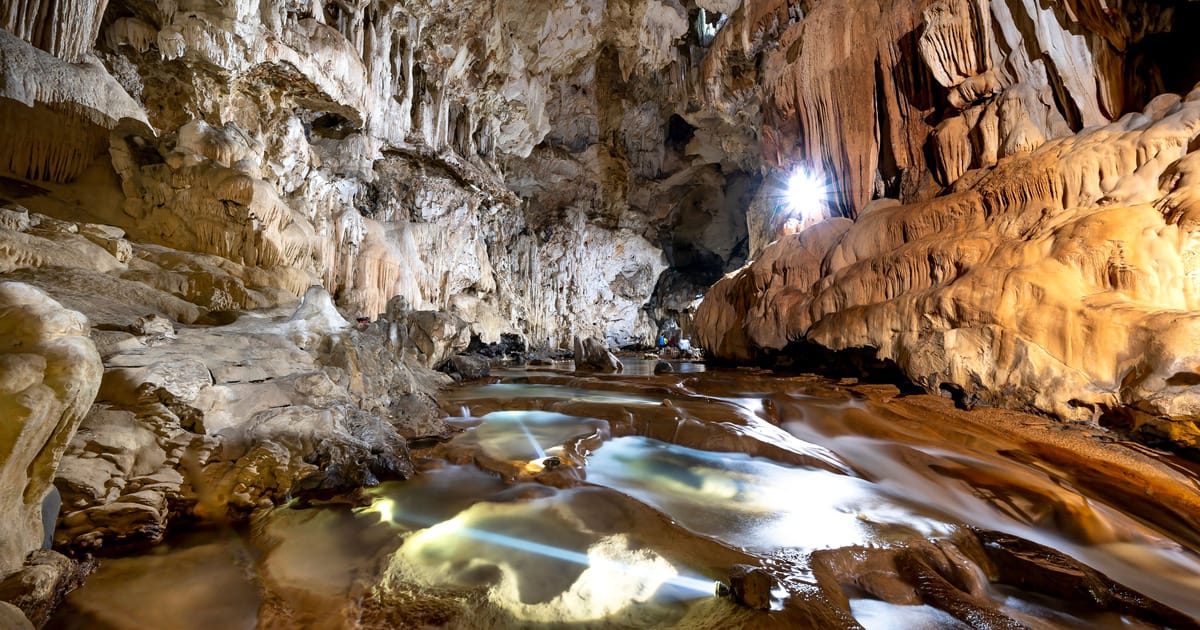
Stalactites and rimstone pools inside Paradise Cave, Phong Nha
What People Who Have Actually Done It Say
The published accounts are almost uniformly positive about the operation and more mixed about the cave itself. That split is the useful part.
The praise is for logistics, not scenery. Guests name their guides and safety assistants, rate the food highly, and describe an operation with nothing improvised about it. One couple who did the shorter Hang Va expedition first and Son Doong second call Oxalis a first-class outfit and then say Son Doong itself left them a little flat, because the smaller Hang Va felt more intimate. Read that before you spend US$3,000. Scale is the whole proposition here, and scale does not land the same way for everyone.
The warnings are consistent and physical. The UK Ambassador to Vietnam, writing after his own trip, describes a rope-assisted 80-metre descent down steep, slippery rock into the cave, and counts sweat, mud, leech bites and wet feet as part of the deal. One trip report notes the walking opens with a steep jungle descent and no warm-up at all, with knee strain arriving in the first hour.
The turn-back rule is independently documented. Lonely Planet's own entry states that anyone struggling with the climbing sections is sent back on the first day. This is not a formality that Oxalis quietly waives.
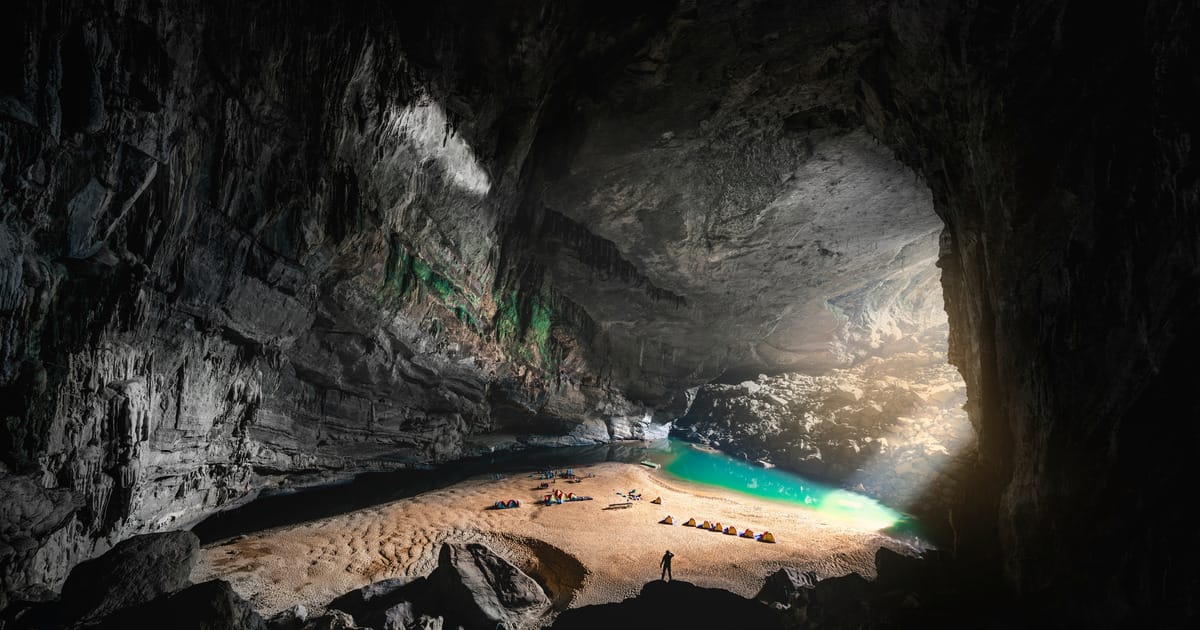
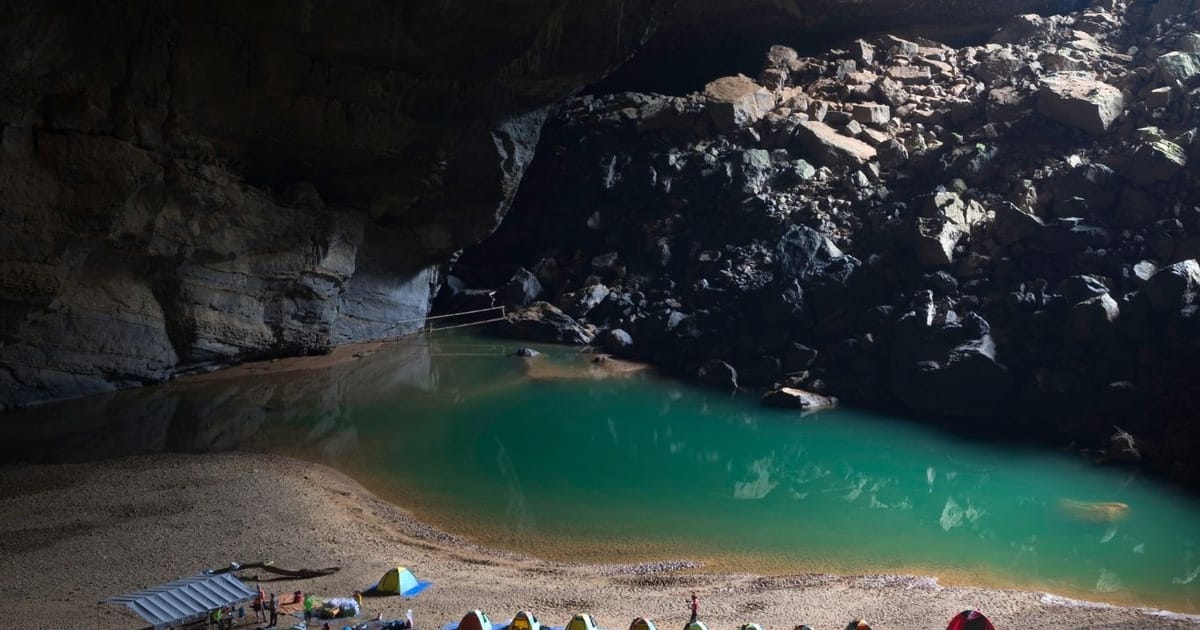
Aerial view of the iconic subterranean campsite and emerald pool inside Hang En
Fitness: the Published Bar
Son Doong is an advanced expedition, not a soft adventure with a hard-sounding name. Oxalis publishes exactly what it expects.
You must be able to:
Be aged between 18 and 70
Show trekking experience from the last 12 months: at least one overnight trek, plus one or two day treks of at least 8 km a day with 300 m or more of elevation gain
Run 5 km continuously in under 50 minutes
Climb five flights of stairs without getting out of breath or dizzy
And the trip itself involves:
25 km of trekking on jungle and mountain trails, with elevation changes up to 800 m
8 km of caving over rock, with fixed-rope sections
Repeated river crossings, knee-deep or more depending on weather
A 90 m descent into the entrance and a 90 m climb out over the Great Wall
Three nights in a tent, with washing limited to the underground lakes at Hang En and Doline 1; the Doline 2 campsite has no water for bathing
You do not need previous caving experience. You do need previous trekking experience, which is a different thing, and it is a hard requirement rather than a recommendation.
Skip or defer if you have a knee injury that flares under load, a heart condition without recent clearance, or you land in Vietnam within 48 hours of Day 1. There is no phone signal in the park and the rescue team can take hours to reach a casualty, which is the real reason the screening is strict.
Trekker climbing a rock section inside Son Doong Cave
Where It Is, and Getting There
Son Doong is inside Phong Nha-Ke Bang National Park, a UNESCO World Heritage site inscribed in 2003 for its karst geology and extended in 2015 for its biodiversity. The park is in Quang Tri province, after the former Quang Binh and Quang Tri provinces were merged into a single enlarged Quang Tri province in mid-2025. Older articles and some signage still say Quang Binh. The park has not moved.
The trip runs out of Phong Nha town, not Dong Hoi. Dong Hoi has the nearest airport, about 45 km away.
Fly to Dong Hoi (VDH). Daily from Hanoi and Ho Chi Minh City, then a 45 to 50 minute transfer. Fastest.
Overnight train from Hanoi. Around 10 hours to Dong Hoi. Cheaper, and easier on the body than a dawn flight if you are trekking soon after arrival.
Road from Hue. Around 4 hours, useful on a central Vietnam loop that includes the Imperial City of Hue.
Give yourself a rest day in Phong Nha before Day 1. Arriving jet-lagged is a reliable way to underperform on the trek.
Ho Khanh found the entrance in 1990 while foraging for agarwood, lost it, and only found it again in 2008. The British-Vietnam Caving Expedition Team led by Howard and Deb Limbert entered in 2009 and completed the survey on 17 March 2010, measuring nearly 9 km of passage and a volume of 38.5 million cubic metres. National Geographic confirmed the scale in 2011, and Mark Jenkins' feature set the visual template for almost everything written about the cave since.
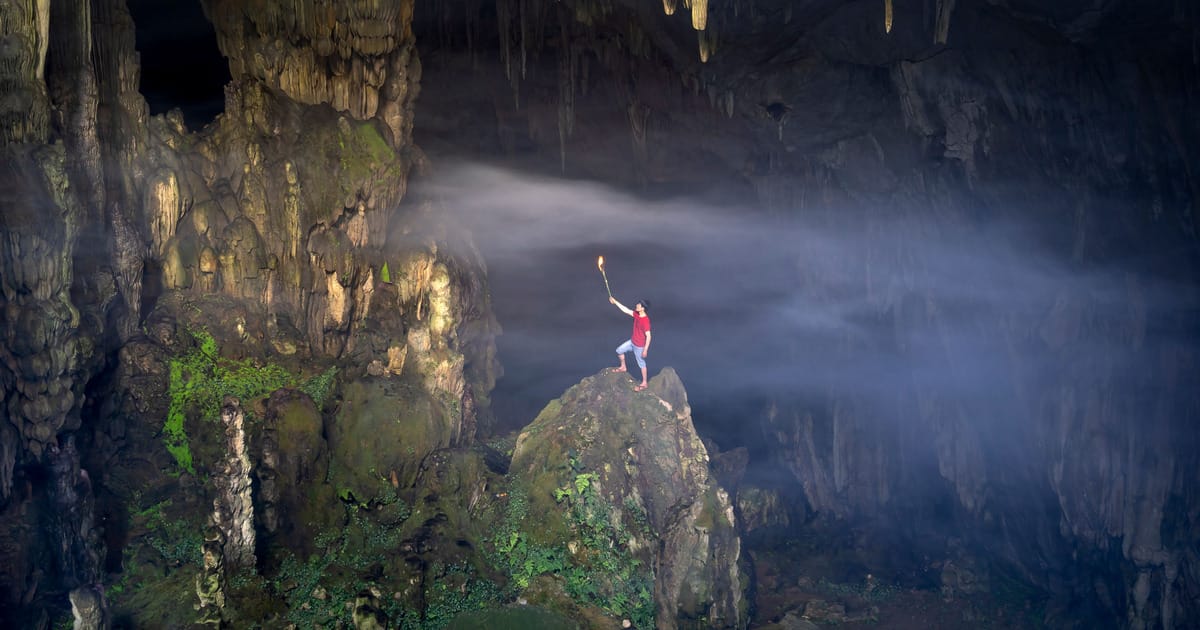
An explorer holding a torch amidst the mist inside a colossal cave
If You Cannot Get a Permit
Most people who read about Son Doong will not go on Son Doong. The cap is 1,000 a year, 2027 is already full, the price is US$3,000, and the fitness bar is real. For most readers this is the section that matters.
Alternative | Length | Price | What you get |
|---|---|---|---|
Hang En | 2 days, 1 night | VND 8,800,000 | The same Day-2 trek route as Son Doong; beach camp under a giant entrance dome |
Hang Ba Deep Jungle | 4 days | VND 38,600,000 | Oxalis's own recommended substitute; level 6, same difficulty as Son Doong |
Tu Lan cave system | 1 to 5 days | from VND 2,000,000 | Swim-through caves and waterfalls in a separate karst massif; family grades available |
Paradise Cave | Half day | about VND 250,000 | Dry walk-in show cave on a boardwalk; deeper guided route on advance booking |
Phong Nha Cave | About 2 hours | Low | Wooden boat drift through the illuminated cave that named the park |
Hang En is the strongest single answer. It is one of the world's largest cave passages, it sits on the same route as Son Doong's first trekking day, and it costs VND 8,800,000 per person including park entrance and environmental fees, roughly a ninth of Son Doong. If you have three or four days instead of a week, book this.
Hang Ba Deep Jungle Expedition is what Oxalis itself points people towards when Son Doong is full. It is rated at the same level 6 difficulty and focuses on wildlife and conservation rather than cave scale.
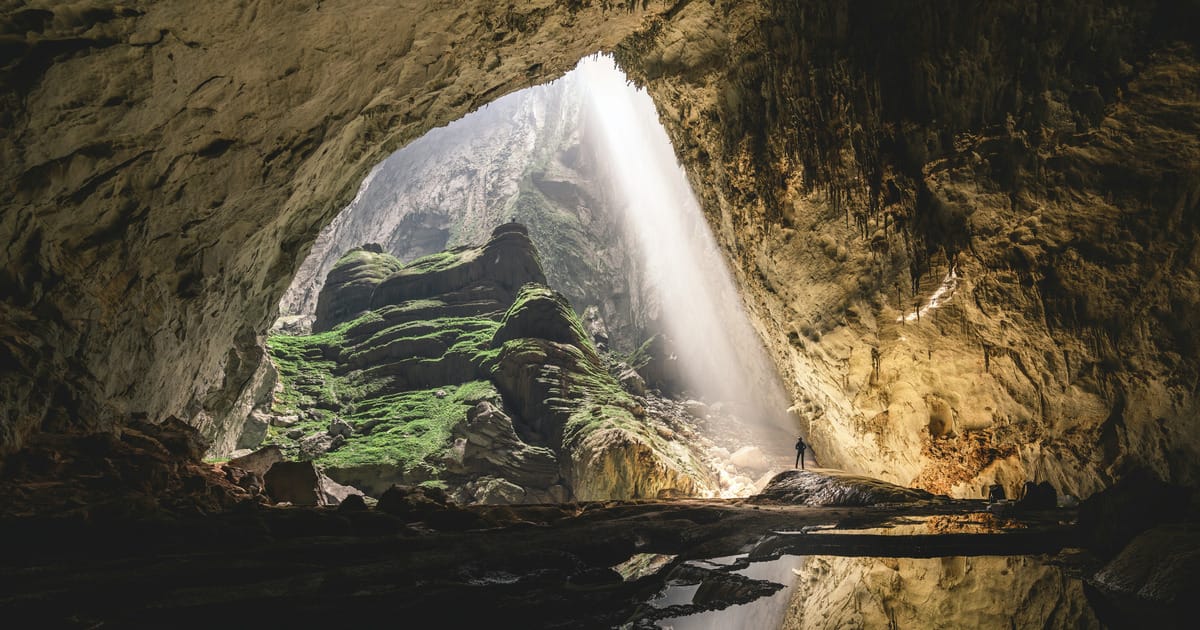
Sunbeam pouring into the colossal chamber at Son Doong Cave
Son Doong is not a bucket-list photograph you buy. It is a six-day trip run by one company, capped at 1,000 permits, priced at US$3,000, closed for a third of the year, sold out for 2027, and gated by a fitness test that is enforced on the trail rather than on the form.
If those numbers work for you, get on the list early and start walking hills with a weighted pack. If they do not, Hang En sits on the same jungle route and shows you the same landscape at a ninth of the cost. Either way, the trip worth taking is the one you are fit enough to enjoy.
If you are building a wider central Vietnam trip around a Phong Nha stop, Meetup Travel can sequence Hue, Phong Nha and Ninh Binh so the driving and rest days line up. The Son Doong permit itself stays with Oxalis, where it belongs. For how Phong Nha fits into a longer route, see our Vietnam Ultimate Guide 2026.